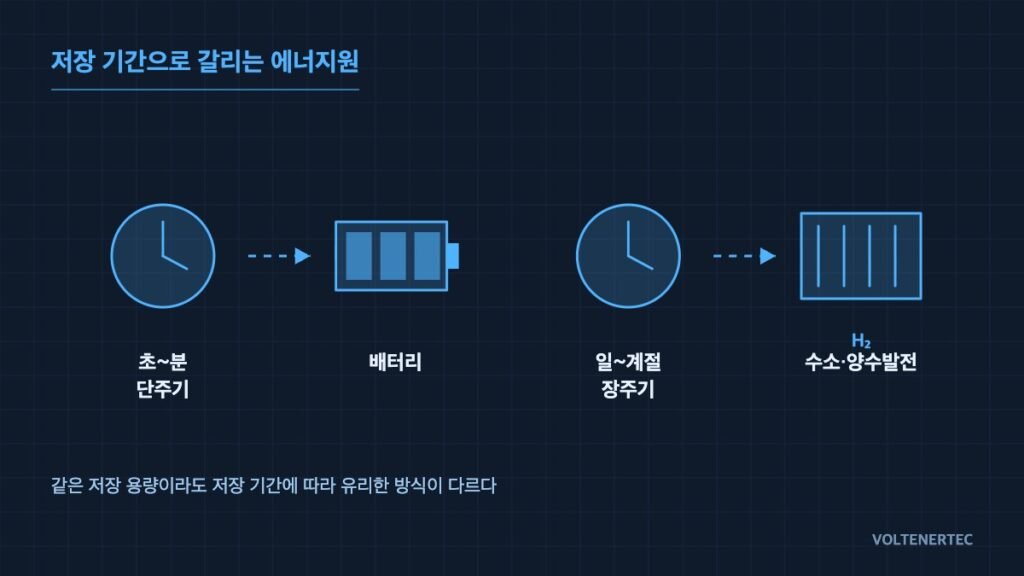
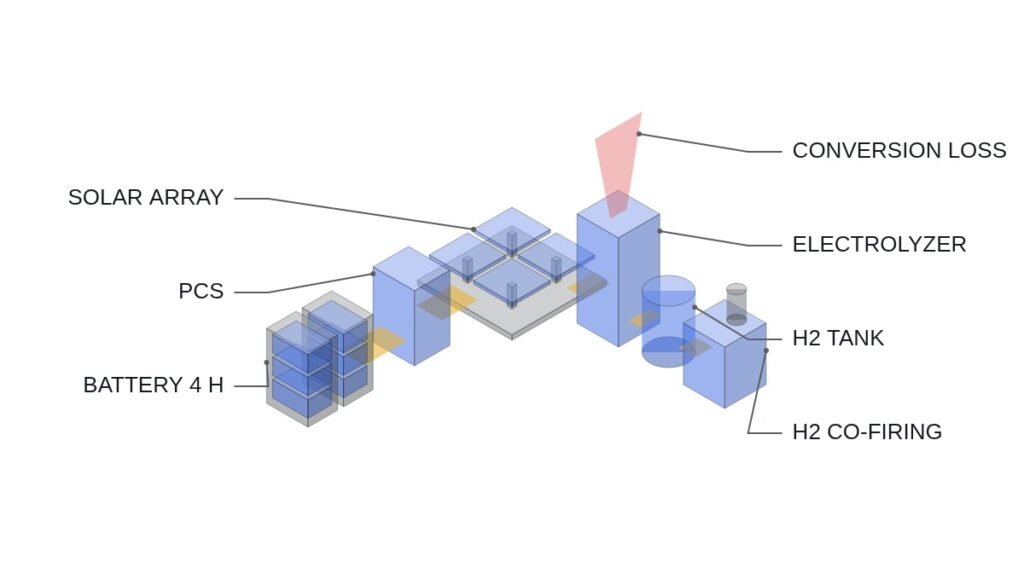
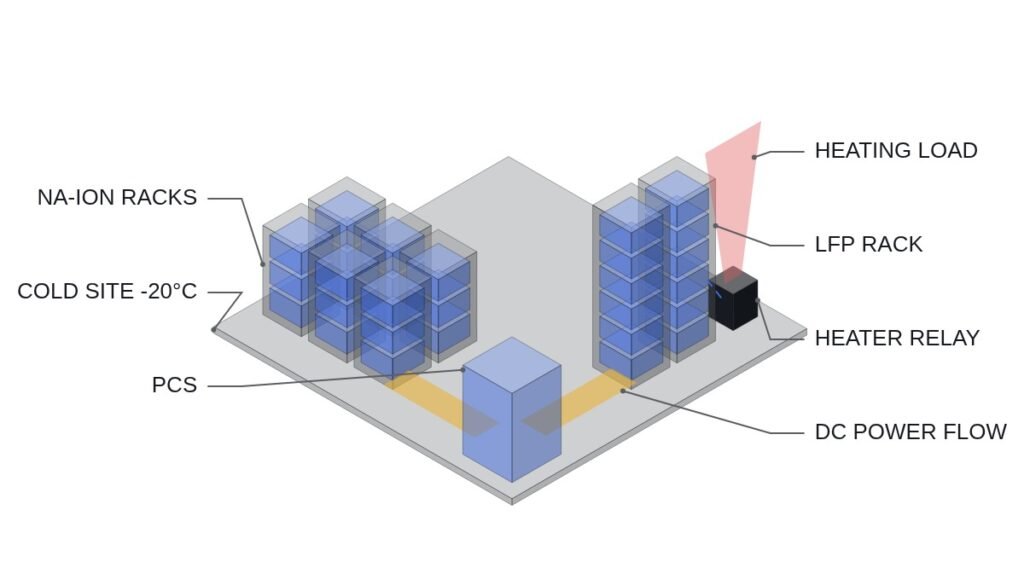
Here is the conclusion up front. What separates thermal storage (molten salt, solid heat storage) from electrical storage (battery ESS) is not the efficiency of the storage medium but whether the stored energy is finally used as heat or as electricity. If the end use is process heat or space heating, converting electricity to heat first and storing it wins on both energy loss and storage-medium cost per kWh. If the stored heat has to be turned back into electricity, heat-engine efficiency multiplies in and round-trip efficiency collapses, so battery ESS wins. Under the same word “storage,” the two technologies are really solving different problems.
Where it wins, where it doesn’t
Where thermal storage wins
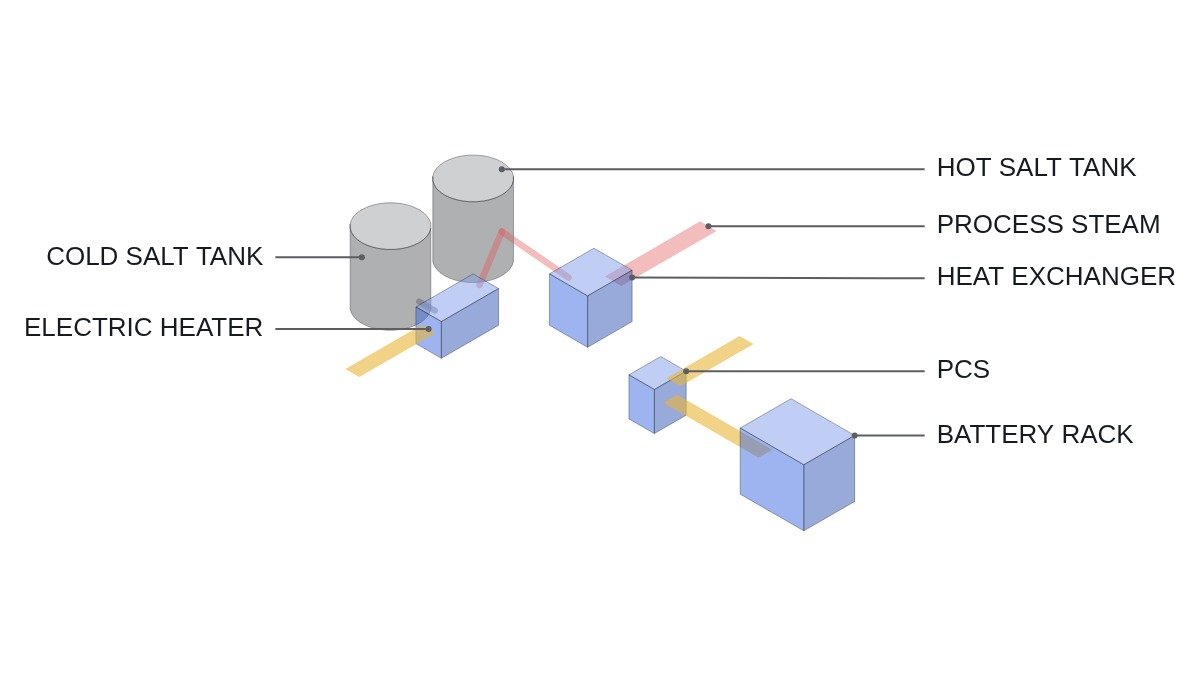
The current conditions: a plant uses steam or high-temperature process heat around the clock, makes it with gas boilers, and sees power prices drop during daytime renewable surplus. With thermal storage, cheap-hour electricity runs electric heaters that heat molten salt or a solid storage medium, and steam is drawn through a heat exchanger when needed. The logic is the number of conversions: electricity becomes heat only once, so losses are small, and tanks or storage media are a cheaper vessel per kWh than cells. The existing gas boiler can stay as backup, so the process keeps running even when the store is empty.
Where battery ESS wins
If the end use is electricity and value comes from electrical output, such as peak shifting or frequency response, batteries are the fit. A battery takes in electricity and sends out electricity, so conversion stops at a single PCS stage. The logic is the return-trip loss: the moment energy stored as heat is converted back to electricity, thermodynamic limits apply.
Where thermal storage loses
When heat demand stops seasonally, or the required temperature falls outside the storage temperature range, the advantage of thermal storage disappears. Molten salt must also be kept above its freezing point, so in duty that stores for long periods without drawing heat, insulation and trace-heating power become a burden.
Efficiency by path
Compare four paths that store the same 1 kWh of electricity and deliver it to the end use. Assumptions: electric heater efficiency 99%, thermal store retention 95% (including heat loss during storage), battery round-trip efficiency 88%, steam cycle generating efficiency 40%.
| Path | Calculation | Net efficiency |
|---|---|---|
| Power → thermal store → heat | 0.99 × 0.95 | About 94% |
| Power → battery → heater → heat | 0.88 × 0.99 | About 87% |
| Power → battery → power | 0.88 | 88% |
| Power → thermal store → turbine → power | 0.99 × 0.95 × 0.40 | About 38% |
Read the table as two pairs. In the top pair, where the end use is heat, thermal storage leads on efficiency, and the gap widens once storage-medium cost is included. In the bottom pair, where the end use is electricity, the thermal path delivers less than half of what the battery does. The same thermal storage plant can be the best or the worst choice depending on which pair it belongs to.
Heat pumps change the arithmetic
If the supply temperature is within what a heat pump can reach, a path using a heat pump instead of an electric heater opens up. Assumptions: heat pump coefficient of performance (COP) 3, low-temperature store retention 95%. One kWh of electricity makes 3 kWh of heat, and after storage loss about 2.85 kWh of heat reaches the process. That beats every row in the table above. But heat pump COP falls as supply temperature rises, and there is an upper limit on the temperature it can deliver, so high-temperature process heat still needs electric heaters paired with molten salt. In the end, the temperature grade of the heat demand decides even the type of thermal storage.
Sizing molten salt storage
Sensible heat storage follows Q = m × c × ΔT. Assumptions: sodium nitrate and potassium nitrate salt mixture, specific heat c = 1.5 kJ/kg·K, operating temperature swing ΔT = 275 K (the difference between cold and hot tanks).
One tonne of salt stores 1,000 × 1.5 × 275 = 412,500 kJ, about 114.6 kWh of heat. Storing 100 MWh of heat takes 100,000 ÷ 114.6 ≈ 873 t. Halve the temperature swing and the requirement doubles. In other words, thermal storage capacity is the product of medium mass and temperature swing, and if the process requires a high supply temperature that forces the cold side up, the usable energy of the same tank shrinks.
The charging side matters too. Filling 100 MWh of heat within a 5-hour cheap window at the assumed 99% heater efficiency needs about 100 ÷ 0.99 ÷ 5 ≈ 20.2 MW of electrical load. Whether the plant’s service connection can take that additional load is often the real upper limit on system size.
Side-by-side comparison
| Item | Thermal storage | Battery ESS |
|---|---|---|
| Output form | Heat (steam, hot water) | Electricity |
| Capacity set by | Mass × temperature swing | Cell count |
| Back to power | Heat engine, large loss | One PCS stage |
| Standby loss | Heat loss, trace heating | Self-discharge, auxiliaries |
| Response | Heat exchanger time constant | Sub-second |
| Main hazard | High temperature, freezing | Thermal runaway |
The first and third rows are effectively the whole decision. If the output is used as heat, choose thermal storage; if it must go back to electricity, choose batteries. The remaining rows are items to check when configuring equipment after the side has been chosen.
Decision sequence
- Fix the end-use form of the stored energy. If it is heat, write down the required supply temperature and annual hours of use as well.
- Choose the storage medium by supply temperature. For hot water or low-pressure steam, consider water storage or a heat pump combination; for high-temperature process heat, consider molten salt or solid storage.
- Calculate the required medium mass with the formula above, and fold heat loss and trace-heating power during storage into net efficiency.
- If some electrical output is also needed, compare against a separate battery rather than a heat-to-power path.
- Confirm the length of cheap charging hours and the supply contract terms.
Items to verify
- Actual specific heat, freezing point and upper temperature limit of the chosen salt mixture (supplier property data to be confirmed)
- The process’s required steam pressure and temperature, and heat exchanger design conditions
- Actual heat loss from the storage tanks (requires field measurement for each installation)
- Impact of a large electric heater load on the service equipment and grid (harmonics require waveform analysis and field measurement)
Boundary conditions
The advantage of thermal storage flips the moment heat demand disappears. If the process electrifies and steam demand falls, or long seasonal periods pass without heat use, the stored heat has to be turned back into electricity, and from then on it is locked into the roughly 38% path. Conversely, the battery’s advantage shrinks at sites whose end use is mostly heat: storing electricity in a battery and then burning it in a heater means putting energy in an expensive vessel only to use it as heat. And where heat demand falls within the temperature range of heat pumps, a heat pump plus low-temperature storage can beat both options, so it deserves a separate review.
The single selection criterion: if the stored energy is finally consumed as heat, choose thermal storage; if it is consumed as electricity, choose battery ESS.