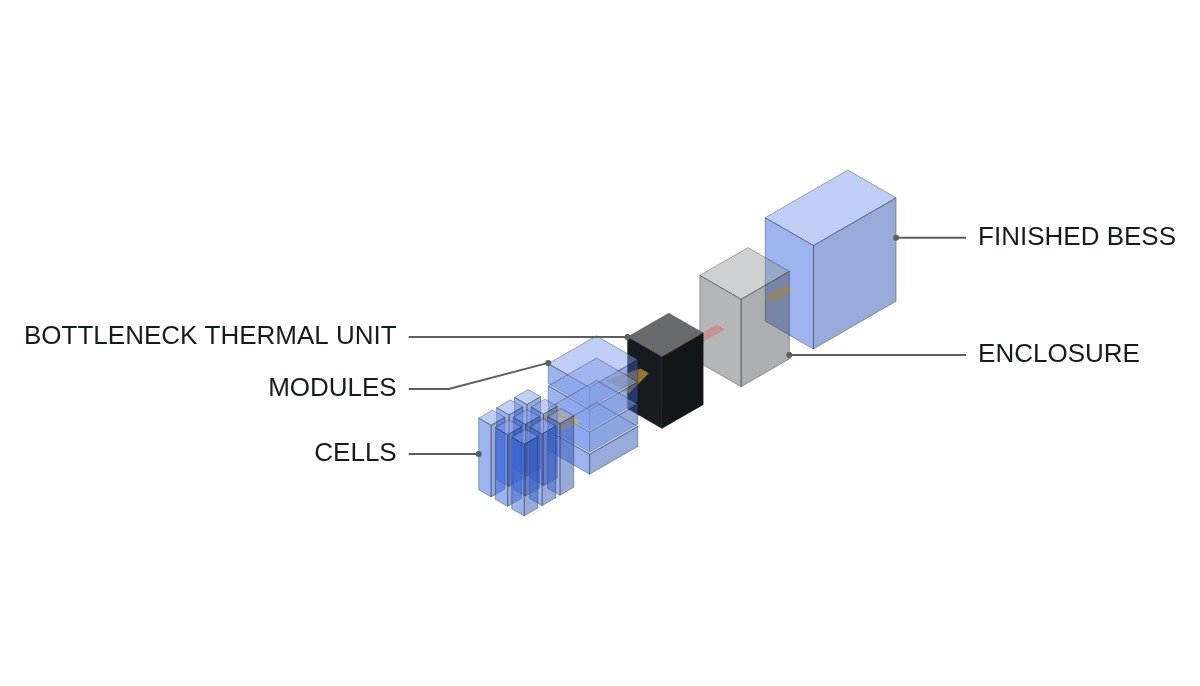
Bottom line first. The 206 GWh cell supply framework between Fluence and EVE Energy is best read as a signal that one integrator has split its supply chain cleanly into a “US track” and a “non-US track.” In the same week, Fluence cut its fiscal-year revenue outlook by USD 600 million because of production delays at its US plants, and the bottleneck was not cells but the welding process for thermal management units. The lesson on the equipment side is that balance-of-plant (BOP) production capacity, more than dual-sourcing of cells, decides delivery dates. However large the cell contract, the number of thermal management units and enclosures coming off the line each day sets how much is actually delivered.
What was reported
On September 21, Energy-Storage.News reported that Fluence and Chinese lithium-ion battery maker EVE Energy signed a 206 GWh battery supply framework agreement for 2027–2031. The 16 GWh for 2027 is committed; the 190 GWh for 2028–2031 is reserved. The outlet described it as one of the largest deals of its kind. EVE Energy ranks among the top three BESS cell suppliers; according to the article it manufactures mainly in China, and its only non-China facilities to date serve the EV market.
Fluence operates in 17 territories, with roughly half its deployments in the US. Citing Fluence’s pursuit of a fully FEOC (foreign entity of concern) compliant supply chain for US projects, the article said the agreement presumably covers projects outside the US. EVE Energy’s share price rose 6–7% on the announcement, and EVE said it could not yet estimate the impact on its finances.
On September 17 the same outlet reported Fluence’s cut to its FY2026 outlook (year ending September 30). Revenue guidance fell from USD 2.9–3.1 billion in August to about USD 2.4 billion, and adjusted EBITDA from a loss of about USD 10 million to a loss of about USD 200 million. CEO Julian Nebreda said about 80% of the revenue shortfall came from US production issues.
Breaking down the USD 600 million shortfall
| Cause | Amount (reported) | Equipment reading |
|---|---|---|
| Production delays | USD 450 million | Process capacity shortfall |
| Late-delivery penalties | approx. USD 65 million | Delivery clauses turned into cost |
| Logistics issues | approx. USD 85 million | Site delivery schedule slips |
| Total | approx. USD 600 million | Fiscal-year revenue reduction |
The three items sum to USD 600 million, matching the reported reduction. The row to watch is the penalty. It means a factory bottleneck did not stop at delayed output but converted straight into contractual cost, showing how delivery clauses in EPC and integration contracts hand supply chain risk right back to the integrator.
The bottleneck was thermal management, not cells
According to the report, the Houston thermal management system plant, opened in August 2025, targeted 11 units a day but initially produced less than one. Automated welding failures and a shortage of skilled labor were cited; Fluence switched to manual welding with subcontractor support and has since raised output to an average of 3 units a day. Utah has produced battery modules since 2024, Arizona has produced BESS enclosures since mid-2025, and cells are sourced from a facility in Tennessee.
Current output against target is 3 ÷ 11 ≈ 27%. Assuming one thermal management unit per containerized BESS, finished units that can ship are capped by the number of thermal management units even if cells and modules are plentiful. That assumption depends on product configuration and needs checking.
Where it wins, where it doesn’t
Current conditions
The article explains that in the US, tariffs, IRA incentives, FEOC restrictions and recent import restrictions on inverters and transformers have combined to make local production a de facto precondition. Outside the US, price competition comes first and institutional constraints on using Chinese cells are comparatively light.
After dual-tracking the supply chain
The integrator runs a local-sourcing track for the US and a Chinese-cell track for other regions. Cell price and volume stability come from the non-US track; the US track gains policy eligibility but takes on plant utilization risk.
The connecting logic
Even with the same cell chemistry, if the cell maker and form factor differ, the two tracks need separate BMS parameters, thermal designs and fire test results. Under the same brand, field engineers end up receiving two kinds of equipment.
| Item | US track | Non-US track |
|---|---|---|
| Cell sourcing | US cell plant | EVE Energy (made in China) |
| Regulatory requirement | FEOC, local content | Relatively relaxed |
| Main risk | Plant utilization, skilled labor | Policy change, logistics |
| Volume certainty | Tied to plant yield | 16 GWh committed for 2027 |
The conclusion from this table is that the two tracks carry risk in different places. For the US track the risk is “can it be built,” for the non-US track “can it be brought in,” and an owner should first confirm which track its project is assigned to.
What owners and operators should check
- Confirm the track: have the cell manufacturer and production location stated in the contract’s technical specification.
- Match the test reports: confirm that the fire propagation test report was performed on the actual cell/module combination being delivered. If the cell source changes, the report must change too.
- BMS parameters: before commissioning, check that voltage limits, temperature alarms and balancing settings match the cell maker’s datasheet.
- BOP delivery: confirm plant-by-plant capacity and delivery dates for thermal management units, enclosures and PCS separately from cell delivery.
- Penalty structure: confirm how supplier delays pass through the integrator into the owner’s schedule, and how liability is allocated if commercial operation slips.
Boundary conditions
The case for dual-tracking reverses under the following conditions. First, when restrictions on Chinese cells are introduced outside the US as well; execution of the 190 GWh reserved volume then becomes uncertain. Second, when US plant yields reach target and costs come down; maintaining two tracks then becomes an overhead burden. Third, when the framework’s reserved volumes are tied to price renegotiation terms. The contract details were not disclosed and remain an item to verify.
The single decision rule is this: when evaluating a BESS supply contract, check first whether the daily production capacity of BOP such as thermal management units and enclosures meets the contract delivery schedule, before looking at committed cell volume (GWh).
References
- Energy-Storage.News, “Fluence and Eve Energy agree 206GWh battery supply deal”, 2026-09-21, https://www.energy-storage.news/fluence-and-eve-energy-agree-206gwh-battery-supply-deal/
- Energy-Storage.News, “Fluence cuts 2026 revenue & EBITDA guidance as US production delays bite”, 2026-09-17, https://www.energy-storage.news/fluence-cuts-2026-revenue-ebitda-guidance-as-us-production-delays-bite/