VOLTENERTEC WEEKLY · 2026 Week 38 · 3/5
To state the conclusion first: for a new renewable-energy developer, a competitive-auction fixed-price contract market becomes advantageous when financing cost outweighs revenue volatility. It is disadvantageous, conversely, for a developer with the balance-sheet strength and own capital to bet on rising REC prices, and for a single-project developer with no alternative sales channel if the auction fails. Since the Renewable Energy Certificate (REC) spot market remains until December 31, 2029, there are only three years left to defer this decision.
What Is Changing
The Ministry of Climate, Energy and Environment announced that the amended Act on the Promotion of the Development, Use, and Diffusion of Renewable Energy was promulgated on September 15, 2026 and takes effect January 1, 2027, as a follow-up to the amendment passed by the National Assembly plenary session on August 20, 2026. The Renewable Portfolio Standard (RPS) system, introduced in 2012, is being consolidated into a competitive-auction-based, long-term fixed-price contract market.
For new facilities, developers are selected through competitive auction within a government-set ceiling price in a contract market organized by generation source, and the winning developer signs a long-term fixed-price power purchase agreement with KEPCO. Bid evaluation includes not only price but non-price factors such as contribution to the domestic industry/supply chain and to energy security.
The Advantaged Position and the Disadvantaged Position
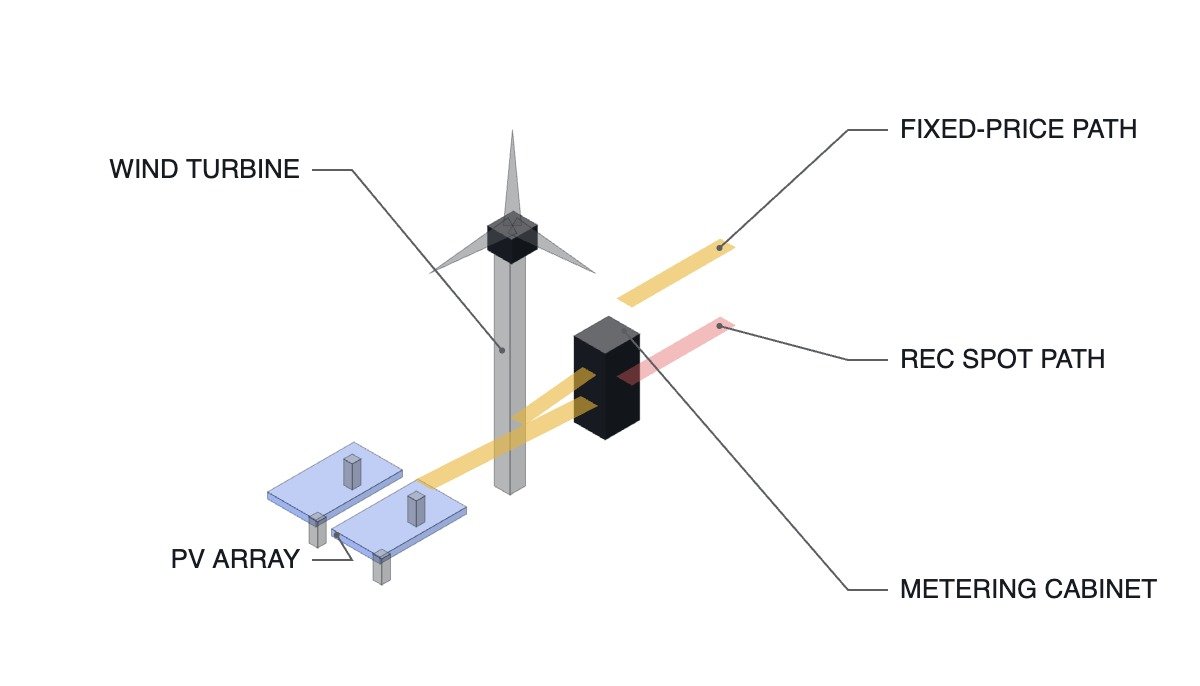
Under current conditions, a renewable-energy developer’s revenue is the sum of the System Marginal Price (SMP) and the REC price, and of the two, the REC price moves with spot-market supply and demand. Financial institutions price this volatility as risk and add it to the interest rate. As a result, financing cost has been embedded in the levelized cost of generation.
Once the market shifts to fixed-price contracts, revenue is fixed for a long period after winning the auction. As volatility disappears, the financial institution’s risk premium shrinks and the financing rate comes down — this is exactly the effect the government expects. In exchange, though, the developer must compete on price against other bidders within the ceiling price. In effect, the lower financing cost gained by removing the risk premium is handed back out again as a lower bid price.
The chain of reasoning follows from here. It is advantageous when the drop in financing rate is larger than the cut forced by bidding competition, and disadvantageous when it is smaller. In other words, the lower a project’s equity share and the higher its reliance on project financing, the more this system favors it. Conversely, a developer building with its own capital — whose financing cost was already low — simply inherits the price competition with none of the offsetting benefit.
| Category | Existing RPS / REC Spot | Competitive-Auction Fixed-Price Contract |
|---|---|---|
| Revenue structure | SMP + REC (price fluctuates) | Long-term fixed, based on winning bid price |
| Price determination | Spot-market supply and demand | Competitive auction within a government ceiling price |
| Evaluation factors | Price (certificate trading) | Price + domestic industry/supply-chain/energy-security contribution |
| Counterparty | Obligated suppliers (multiple) | KEPCO (long-term fixed-price PPA) |
| Financing | Premium reflecting volatility | Fixed-revenue basis, financing conditions expected to improve |
| Existing facilities | Certificates continue to be issued, in principle up to 20 years | Spot market operates through 2029-12-31, then sunsets |
| Small-scale facilities | Spot market and fixed-price contracts run in parallel | Separate contract market planned (details unconfirmed) |
The table says one thing. This reform is not a system to lower the generation cost of renewable energy, but a system to shrink the share of financing cost within that generation cost. For a project whose equipment, construction, and grid-connection costs stay the same, the room to lower the winning bid price is limited to the drop in financing rate. The number to calculate for a bidding strategy is not the module unit price, but the project’s own weighted average cost of capital (WACC).
What to Prepare on the Equipment Side Now
Even though this is a policy reform, there is equipment-side work to do. Because a long-term fixed-price contract uses generation output as the settlement basis for the entire contract period, the reliability of metering data becomes directly the reliability of revenue.
- Check whether the metering chain is redundant and confirm the calibration validity period of the meters. Verify whether the structure allows gaps to occur in the settlement metering values.
- Check the retention system for curtailment-command receipt and execution records. Generation loss caused by executing a curtailment command must be distinguishable in the log from generation loss caused by equipment failure.
- Check the local storage capacity for metering data during a communications outage. Confirm whether the configuration allows retroactive transmission once communications are restored.
These items were already necessary under the spot-market regime, but once revenue is locked to a fixed price, the “sell more when the price is good to make up for it” option disappears — so the cost of a single data gap grows accordingly.
What Is Not Yet Confirmed
The following items cannot be judged from what has been disclosed so far. They are left as items requiring confirmation, not estimated.
- The level and calculation method of the ceiling price by generation source
- The scoring and evaluation criteria for non-price factors (domestic industry/supply-chain/energy-security contribution)
- The capacity threshold and operating method of the separate contract market for small-scale facilities
- The specific level of supply obligation/target management imposed on public institutions and private generators
The Ministry of Climate stated that it will hold a public hearing on the RPS reform on September 30 at the Elienna Hotel in Gangnam-gu, Seoul, to explain the contract-market operating plan and the sunset plan for the existing system, and that, reflecting opinions from the hearing and the legislative-notice period, it plans to complete subordinate-legislation amendments within the year and announce the first auction of the solar/wind competitive-auction contract market alongside the January 1, 2027 effective date. The four items above will be determined in that subordinate legislation.
Boundary Conditions — When This Judgment Reverses
First, if the ceiling price is set low, there will be a range of projects that are not viable even after fully reflecting the financing-cost savings. In that case there is no advantage-or-disadvantage question to weigh — new entry itself is simply blocked.
Second, if the non-price-factor score carries heavy weight, the calculation changes. The rise in equipment cost needed to satisfy the domestic supply-chain conditions could exceed the financing-cost savings. Bid prices cannot be finalized before the scoring weights are disclosed.
Third, the price of the REC spot market that remains until 2029. How the price of a market with an announced sunset will move is not predicted here. What is confirmed, however, is that certificates continue to be issued to existing developers for up to 20 years in principle, so the judgment for existing facilities must be kept separate from that for new ones.
The single selection criterion is therefore set as follows: the competitive-auction contract market is advantageous only for a new project with a high share of project financing and a cost structure that can win within the ceiling price. If that condition does not hold, it is better to defer the investment decision until the ceiling price and non-price scoring weights in the subordinate legislation are disclosed.
Source: Electric Times article (in Korean), September 15, 2026