Renewable sources differ in how they generate power and where they can be built, so a head-to-head comparison is never simple. Still, their characteristics can be laid out clearly using two yardsticks: capacity factor (actual generation as a share of installed capacity) and intermittency.
| Item | Solar | Wind (onshore) | Hydro |
|---|---|---|---|
| Capacity factor | About 15-20% | About 20-30% | About 40% or higher (large-scale) |
| Intermittency | Depends on sunshine hours; no generation at night | Depends on wind speed fluctuations | Depends on rainfall, but relatively stable |
| Siting constraints | Needs large land area and good irradiance | Needs good wind resource; noise complaints | Limited by terrain and water systems; new large sites are scarce |
| Need for ESS pairing | High | High | Relatively low |
Solar and wind are intermittent resources whose output is driven by weather, so they are often paired with ESS (energy storage systems) or other flexibility resources to keep the grid stable. Reservoir hydro can adjust its output and can therefore double as a grid stabilizer, but in an environment like Korea, where large new sites are limited, its room to expand is small.
Reading the table from the grid side
A capacity factor is an annual average. It says how much energy a plant delivers over a year, but it says nothing about when that energy arrives. For a power system engineer, the second question matters more, because protection settings, reserve planning and storage sizing are all driven by the shape of the output curve, not by its yearly total.
Seen this way, the three rows below capacity factor in the table are the ones that decide the design work. Solar output follows a daily pattern that is predictable in shape but drops to zero every night. Wind output does not follow the clock and can change with weather fronts at any hour. Reservoir hydro is the only one of the three where the operator, not the weather, decides the output within the limits of stored water.
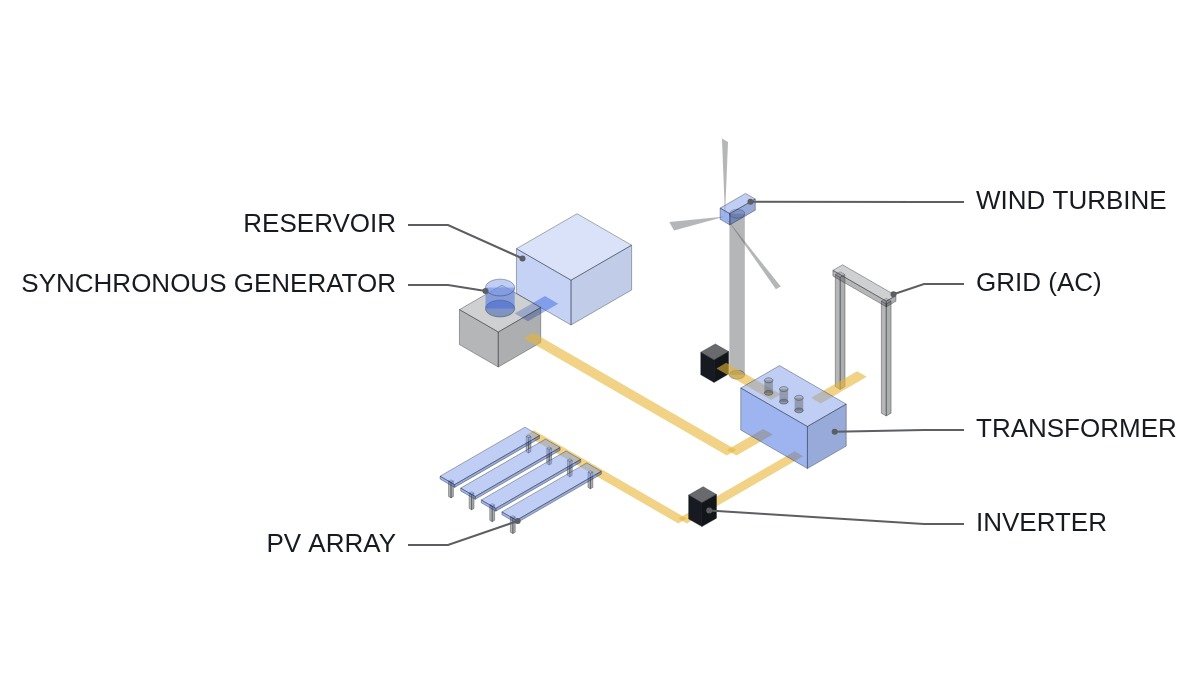
There is also a difference in how each source connects to the grid. Solar and most modern wind turbines connect through power electronic converters (inverters), so their grid behavior is set largely by control software and grid code settings. Hydro uses synchronous generators that are directly coupled to the grid frequency and naturally contribute rotating inertia. This is a structural difference, not a performance ranking, and it changes what the interconnection study has to check.
Character comparison: what each source asks of the grid
| Aspect | Solar | Wind (onshore) | Hydro (reservoir) |
|---|---|---|---|
| Who sets the output | Weather (sun) | Weather (wind) | Operator, within water limits |
| Output pattern | Daily curve, zero at night | Irregular, not tied to the clock | Dispatchable |
| Grid interface | Inverter | Mostly converter-based | Synchronous generator |
| Main grid concern | Midday surplus, evening ramp | Forecast error, sudden ramps | Water availability in dry seasons |
| Role of storage | Shifting midday energy | Smoothing and firming | Can itself act as storage |
The implication is that solar and wind are not interchangeable even though both carry a “High” for ESS pairing. Solar storage is mainly an energy-shifting problem with a repeatable daily cycle, while wind storage is more of a smoothing and forecast-error problem, so the same storage system should not be sized by copying one case onto the other.
Where each wins, where it doesn’t
Solar — Current condition: a site or industrial complex whose load is concentrated in daytime. After applying it: daytime grid purchases fall, while night-time supply still depends on the grid. Linking logic: it wins where the output curve overlaps the load curve. It loses where the load runs mainly at night or around the clock, or where daytime surplus output is already curtailed at the connection point.
Wind (onshore) — Current condition: a site with a good wind resource and enough separation from residents. After applying it: output that is not tied to the clock partly fills the night-time gap of a solar-heavy grid. Linking logic: its value lies in having an output pattern different from solar. It loses near residential areas, and on grids that lack the flexibility resources to absorb forecast errors and sudden ramps.
Hydro (reservoir) — Current condition: a site with suitable terrain and water system. After applying it: the operator sets output within stored-water limits, and the synchronous generator supplies rotating inertia to the grid. Linking logic: it serves as both a generation source and a grid stabilizer. Without a new large site, or with insufficient water in dry seasons, this advantage does not hold.
As the share of inverter-based generation grows, the question of what replaces the inertia and fault support that synchronous generators provide naturally becomes a hidden cost item in source selection. It does not appear in an equipment price comparison, but it always appears in the interconnection study.
Decision order when choosing between them
- Confirm the site first: irradiance and land for solar, wind resource and distance to residents for wind, terrain and water system for hydro. If the site fails here, the other steps do not matter.
- Check the output pattern against the load pattern. A daytime-heavy load fits solar; a load that runs around the clock needs either a dispatchable source or storage.
- Check the hosting capacity of the connection point. Converter-based sources may need grid code functions such as ride-through and reactive power control, which must be confirmed with the grid operator.
- Decide the flexibility resource together with the source, not afterward. Adding ESS after commissioning usually means reworking protection coordination and metering.
- Only then compare capacity factors and cost, because a higher capacity factor is worth little if the energy arrives when the grid cannot absorb it.
Items to verify
- □ Local irradiance or wind measurements for the actual site, not regional averages
- □ Whether the hydro option is reservoir-type (adjustable) or run-of-river (weather-dependent)
- □ Grid code requirements for inverter-based generation at the target voltage level
- □ Curtailment history at the connection area, if available from the grid operator
- □ Actual output fluctuations at the site: requires waveform analysis and field measurement before finalizing storage and protection settings
Boundary conditions
The comparison above assumes large reservoir hydro. Run-of-river hydro follows the river flow and loses most of its controllability, which moves it closer to solar and wind in the table. Likewise, once solar or wind is paired with adequately sized storage, the intermittency row changes and the plant starts to behave more like a dispatchable resource, at the cost of the storage investment. Where hydro sites are available, it keeps the edge as a grid stabilizer; where they are not, the choice between solar and wind turns on which output pattern better matches the local load. The single decision criterion is this: pick the source whose output pattern the connection point and the local load can absorb, and treat capacity factor as a secondary check.