The real design problem in a renewable energy system is not the solar panel or the wind turbine itself. It is how that output is delivered to the grid in a stable way.
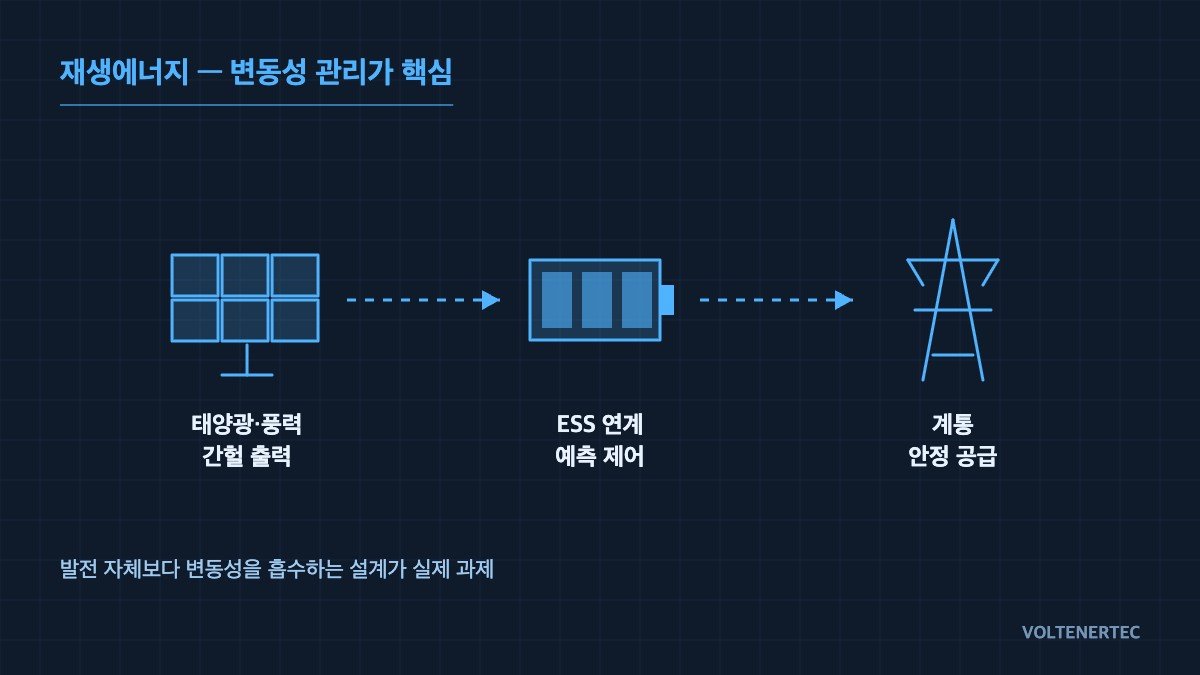
Three ways to handle variability
| Method | What it does |
|---|---|
| ESS integration | Stores the generation peak and releases it when demand arrives |
| Forecast-based output control | Uses weather forecasts to predict output in advance and feeds it into grid operation planning |
| Multi-site distribution | Aggregates plants in several regions so that their individual fluctuations offset one another |
Implication: all three methods sit outside the generating equipment. The variability the grid sees can be reduced without changing the panel or turbine specification, which is why the surrounding design comes ahead of the plant itself.
Why stand-alone operation is difficult
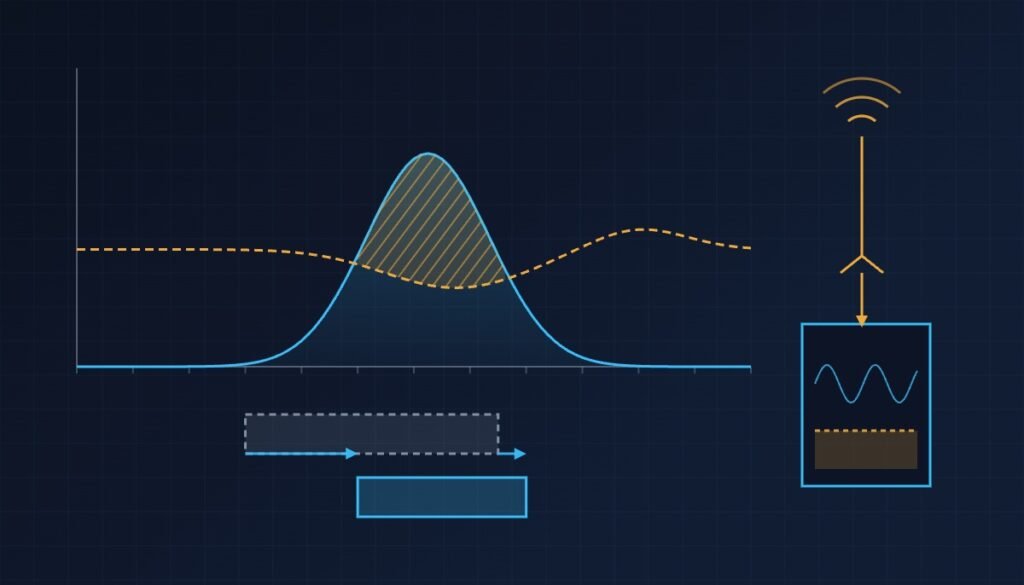
On its own, renewable generation does not line up exactly with demand. Only when a design fills that timing gap (storage, forecasting, distribution) does it function as a “stable power source.”
Summary
The core of a renewable energy system is not the generating equipment but the surrounding design that absorbs variability. Without that design, no amount of generation capacity turns it into a source the grid can rely on.
Reading the three methods from the equipment side
The three methods in the table are often listed as if they were interchangeable options. From an electrical engineer’s point of view they act on different axes of the problem. ESS integration acts on time: it moves energy from the moment it is produced to the moment it is needed. Forecast-based output control acts on information: it does not move energy at all, but it tells the grid operator in advance what is coming so that other resources can be scheduled. Multi-site distribution acts on space: it relies on the fact that plants in different regions do not fluctuate at exactly the same moment.
This distinction matters because each axis puts its burden on a different part of the system. Time-shifting puts the burden on hardware — battery racks, PCS, BMS and the protection and fire-safety equipment that come with them. Information puts the burden on the forecasting process and on the communication path between the plant and the grid operator. Space puts the burden on the network that ties the regions together, since offsetting only works if the aggregated output can actually be transported and dispatched as one.
A practical consequence follows. When a project team says it will “handle variability,” the first question is which of these three axes it is relying on, because the equipment list, the operating responsibility and the failure mode are different for each.
Where each method wins, where it doesn’t
ESS integration. Current condition: generation and demand are offset in time within a single site. After applying it: surplus generation is stored and released later, so the plant’s output profile seen by the grid becomes smoother. Connecting logic: this is the only one of the three methods that physically changes the delivered energy profile at the plant itself, so it is the method that works even when there is no neighboring plant to average against. Its weak side is that every hour of shifting requires installed storage capacity, with the PCS, BMS and safety equipment that come with it.
Forecast-based output control. Current condition: the grid operator sees renewable output only after it happens. After applying it: expected output is known in advance and reflected in operating plans. Connecting logic: variability that is known ahead of time can be covered by other resources prepared for it, so the same amount of fluctuation causes less disturbance. Its weak side is that a forecast does not create or store energy; when the forecast misses, the gap has to be covered by something else.
Multi-site distribution. Current condition: a single plant fluctuates with its own local weather. After applying it: several plants are bundled so that their individual fluctuations cancel out in part. Connecting logic: the aggregated output is smoother than any single plant’s output, without adding storage. Its weak side is that it depends on the regions actually behaving differently at the same time, and on a network that can carry the combined output.
Character comparison of the three methods
| Aspect | ESS integration | Forecast control | Multi-site |
|---|---|---|---|
| Axis it acts on | Time | Information | Space |
| Moves energy? | Yes, stores and releases | No | No, averages output |
| Main equipment burden | Battery racks, PCS, BMS, fire safety | Forecasting process, plant-to-operator communication | Interconnecting network, aggregated dispatch |
| Works at a single site? | Yes | Partly (planning only) | No |
| Typical failure mode | Storage too small for the gap | Forecast miss | Regions fluctuate together |
The table shows that the three methods are not substitutes but layers. Forecasting reduces how much of the variability is a surprise, distribution reduces how large the combined variability is, and storage covers what remains. A design that relies on only one layer inherits that layer’s failure mode in full.
Order of judgment when reviewing a renewable system design
- Define the gap first: what timing mismatch between generation and demand the system is expected to cover, and who carries the responsibility for covering it.
- Check whether the site stands alone or can be aggregated with other plants. If it stands alone, multi-site distribution is not available and the burden shifts to storage and forecasting.
- Check what the grid operator receives from the plant in advance. If no forecast or operating information is provided, the variability arrives as a surprise regardless of how much storage is installed.
- Size the storage against the remaining gap, not against nameplate generation. The purpose of the ESS is to fill the mismatch, so its sizing basis is the mismatch.
- List the equipment and operating burdens each chosen method adds (battery room, fire safety, BMS, communication path, network capacity) and confirm they are in the project scope.
- Treat any fluctuation or communication error observed in operation as undetermined until confirmed — it requires waveform analysis and field measurement before a cause is assigned.
Boundary conditions
The claim that surrounding design matters more than generating equipment holds when renewable output is large enough, relative to the grid it feeds, for its variability to become the grid’s problem. Where the renewable share is small and the grid has ample other resources to follow it, the fluctuation is absorbed without dedicated design, and generation cost becomes the more relevant comparison. The argument also weakens for a site whose output is consumed entirely on the spot by a load that can tolerate interruption, since there is then no grid delivery to stabilize. The single criterion is this: if the variability of the plant has to be absorbed by someone other than the plant itself, the design that absorbs it — storage, forecasting or distribution — is what decides whether the plant counts as a reliable source.