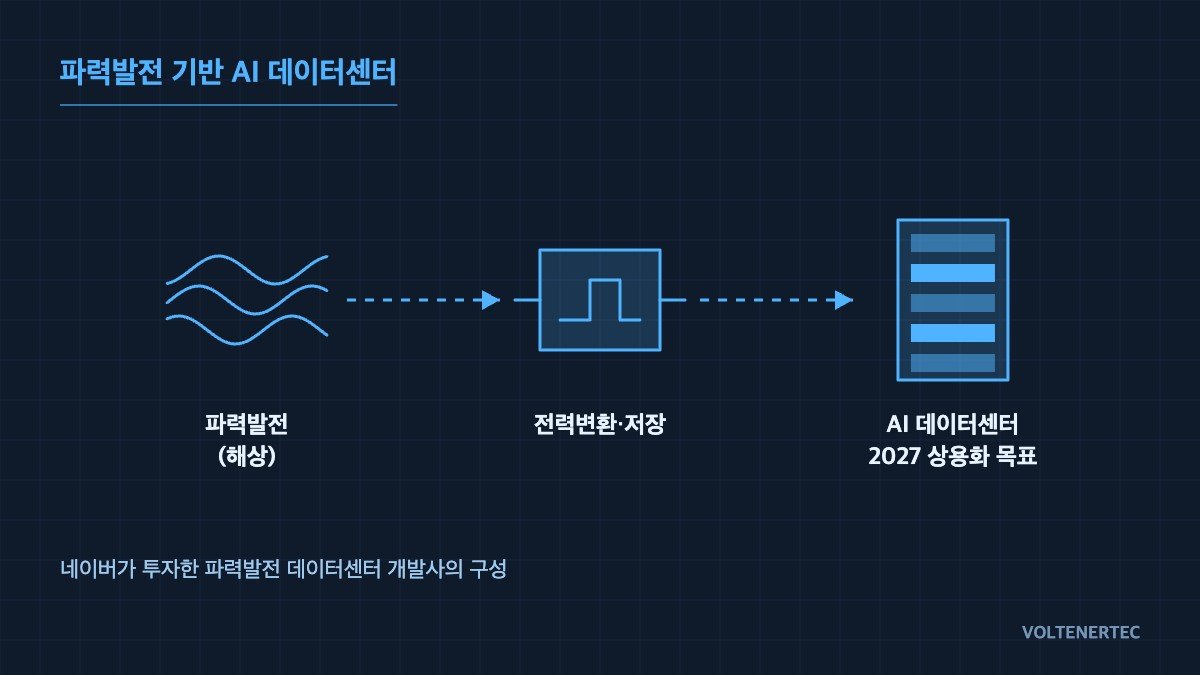
Naver has invested in a developer of AI data centers powered by wave energy, which generates electricity from the force of ocean waves. The developer is targeting commercialization in 2027 and plans to roll out its own power generation platform within the year. As the power consumption of AI data centers grows, this can be read as an attempt to connect a predictable renewable source such as wave power directly to a data center’s own power network.
| Item | Details |
|---|---|
| Investor | Naver |
| Target | Developer of wave-power-based AI data centers |
| Target date | Commercialization in 2027 |
What the announcement actually contains
The published facts are few, and it is worth separating them from interpretation before going further. The investor is Naver. The investee develops AI data centers based on wave power. The target is commercialization in 2027, and the developer plans to deploy its own generation platform within the year. Everything else in this article — how such a system would be configured and what an engineer would need to check — is interpretation from the power-system side, not additional reporting.
The key phrase in the announcement is the direct connection between the generating source and the data center’s own power network. That is a different arrangement from buying renewable electricity through the public grid. In a direct connection, the variability of the source and the reliability requirement of the load meet inside one system, and the designer of that system has to resolve the conflict between them rather than handing it to the grid operator.
Why “predictable” is the word that matters
An AI data center is a load that does not tolerate interruption. From the electrical side, that requirement is normally met with layers: a utility supply, a UPS that bridges short disturbances, and backup generation or storage for longer events. When a renewable source is placed at the front of that chain, the question is not only how much energy it produces over a year but how well its output can be anticipated hour by hour.
A source whose output can be predicted lets the operator plan in advance how much of the load it will cover and how much must come from other supply. A source whose output is a surprise forces the backup layers to be sized for the worst case at all times. The announcement’s emphasis on a predictable source is therefore not a marketing detail; it is the property that decides how much supporting equipment the data center still needs around the generator.
Configuration options for a renewable-fed data center
The announcement does not describe the developer’s actual configuration. The table below compares, in qualitative terms only, the general ways a renewable source can supply a data center, so that the direct-connection approach can be placed in context.
| Aspect | Grid supply + renewable contract | Direct connection + grid backup | Direct connection + storage |
|---|---|---|---|
| Who absorbs variability | Grid operator | Shared: site first, grid as backup | Site itself |
| Dependence on forecast accuracy | Low for the site | Medium | High |
| On-site equipment burden | Conventional (UPS, backup) | Added generator interface and switching | Added storage, PCS, BMS and fire safety |
| Control complexity | Low | Medium: source/grid coordination | High: source, storage and load coordination |
| Link between source and load | Contractual | Physical | Physical |
Reading the table, the further a data center moves from contractual renewable supply toward a physical direct connection, the more the variability problem moves from the grid operator onto the site’s own design. That is exactly why the predictability of the source becomes the deciding property: it determines how much storage and backup the site must carry to keep an uninterruptible load running.
Where a direct connection wins, where it doesn’t
Where it wins. Current condition: AI data center power demand is growing, and supply through the public grid depends on network capacity and connection timing that the data center does not control. After applying a direct connection: part of the supply comes from a source the operator owns or contracts physically. Connecting logic: if the source’s output can be anticipated, the operator can plan around it and reduce dependence on external supply for the share it covers.
Where it doesn’t. Current condition: the load cannot be interrupted. After applying a direct connection without adequate support: any shortfall in the source must be covered instantly by other supply. Connecting logic: the uninterruptible requirement does not go away, so UPS, backup and switching equipment remain necessary, and the benefit of the direct source depends on how much of that equipment it allows the site to avoid or run less.
Items to verify
- The name of the developer, the size of the investment and the investment structure — not specified in the summary above.
- The generation capacity of the platform and the load capacity of the data center it is meant to supply.
- Whether the data center will also have a public grid connection, and which source is primary.
- The storage and backup configuration between the generating platform and the IT load.
- What “commercialization in 2027” covers: the generation platform, the data center, or both.
- Any operating data from the platform to be deployed within the year; output behavior should not be assumed before it is measured, and requires waveform analysis and field measurement.
The first four items determine whether this is a showcase of a new source or a design that meaningfully changes how the data center is powered. The last item is where the claim of predictability will either be confirmed or not.
Boundary conditions
The appeal of wiring a renewable source straight into a data center rests on that source being predictable enough to plan around. If the deployed platform’s output turns out to be harder to anticipate than expected, the site will need storage and backup sized close to the full load, and the direct connection adds equipment without reducing dependence on other supply. The appeal also shrinks if the generation capacity is small relative to the data center load, since the source then covers only a marginal share while the full backup chain stays in place. The single criterion is this: judge the project by how much of the data center’s backup and storage the wave source allows the site to avoid, and that depends on output predictability confirmed by operating data, not on the announcement.