The conclusion first. Switching ESS and UPS batteries from NCM to LFP pays off where there is spare floor area and where 20-odd years of cycle life and fire-safety margin matter more than volumetric energy density. Conversely, where the footprint is tight and you have to squeeze the maximum storage capacity out of every unit of volume, NCM and NCA still lead. LG Energy Solution’s decision to produce NCM for EVs and LFP for ESS side by side at its Lansing, Michigan plant should be read not as a verdict on which chemistry is better, but as the result of assigning each chemistry to its application by exactly this criterion.
1. Background: splitting chemistry by application
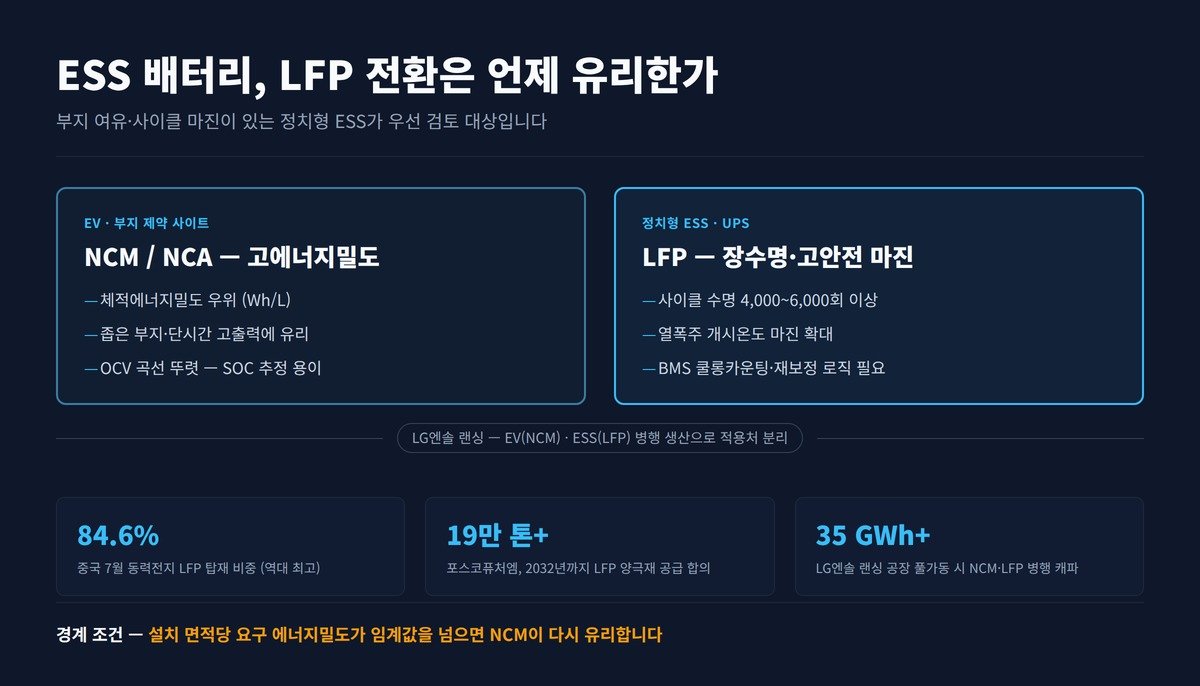
On August 19, news came that LG Energy Solution had started mass production of LFP cells for ESS at Lansing, Michigan (the former Ultium Cells Plant 3). At full utilization the plant is rated at more than 35 GWh, and from 2027 it will supply NCM cells for Toyota and LFP cells for Tesla Megapack from the same site in parallel. Around the same time, POSCO Future M agreed to supply more than 190,000 tonnes of LFP cathode material to a domestic cell maker through 2032, and China’s July traction battery installations hit a record LFP share of 84.6%.
Put the three items side by side and the direction is clear. This is not a fight over which chemistry wins; it is a trend toward assigning chemistries separately by application. Mobile applications (EVs) still lean heavily on NCM, while the center of gravity for stationary applications (ESS) is shifting to LFP. Looked at from an electrical engineer’s point of view, the explanation lies mostly in the cycle life and fire-safety margin of stationary equipment.
2. Where it wins: stationary ESS and UPS with spare site area
Current condition: ESS and UPS are not vehicles. Weight and volume penalties are not as fatal as they are in an EV; instead, cycle life and thermal safety over a 20-odd-year service life dominate the levelized cost of storage (LCOS).
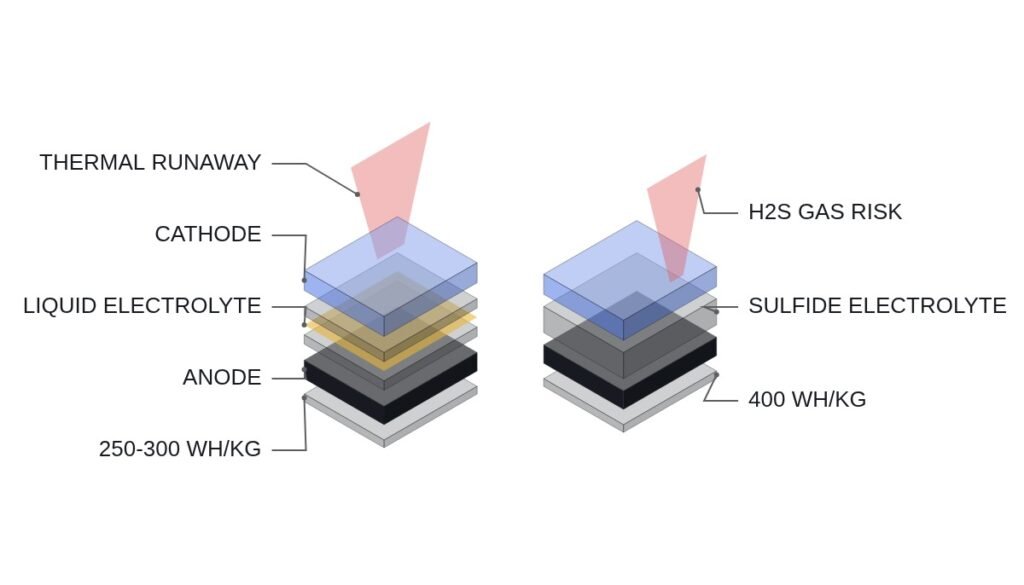
Change after applying LFP: cycle life at 80% DOD extends to 4,000–6,000 cycles or more, versus roughly 2,000–4,000 for NCM chemistries, and the thermal runaway onset temperature often comes out tens of degrees higher than NCM according to cell manufacturers’ datasheets. The margin available to the fire-suppression design widens accordingly.
Connecting logic: that margin means protection relay settings and the fire interlock sequence can be set with more headroom. With the same suppression equipment and ventilation capacity, you buy more response time, which makes it a real driver of lower LCOS from a systems engineering standpoint.
3. Where it doesn’t: space-constrained, short-duration high-power sites
The opposite condition is just as clear. Where installation area is limited and high-power discharge within a few minutes is required, as in a data center UPS, LFP’s lower volumetric energy density becomes a direct obstacle. Securing the same kWh takes more racks, and more racks mean more wiring and more protection coordination points.
LFP volumetric energy density is, of course, still improving. BYD’s premium brand Denza passed 1,000 km on the CLTC cycle with the N8L’s 130 kWh-class LFP pack. That, however, is an achievement of pack design and CTP (cell-to-pack) optimization, not a reversal of the cell chemistry’s inherent position. At sites with severe space constraints, NCM and NCA remain the first candidates.
4. Comparison table: from an ESS/UPS perspective
| Item | NCM / NCA | LFP |
|---|---|---|
| Nominal voltage (V/cell) | About 3.6–3.7 V | About 3.2 V |
| Volumetric energy density (cell) | Relatively high | Relatively low (improving) |
| Cycle life (80% DOD) | About 2,000–4,000 cycles | About 4,000–6,000+ cycles |
| Thermal runaway onset | Relatively low (check datasheet) | Relatively high (check datasheet) |
| SOC estimation (OCV-based) | Distinct curve slope, easy to estimate | Flat curve, BMS algorithm correction needed |
| Standards and certification | Many UL 9540A / IEC 62619 cases | Same standards, more test headroom from thermal margin |
| Best-fit applications | EV, space-constrained ESS/UPS | Stationary ESS, long-duration storage |
The row to watch in this table is not energy density but SOC estimation. LFP’s voltage curve is flat, so OCV alone cannot pin down SOC accurately; coulomb counting and periodic recalibration logic must be built into the BMS. In other words, the decision to change chemistry is also a decision to redesign the BMS logic.
5. What changes in protection and interlock design
When the chemistry changes, the thermal runaway detection thresholds and the response sequence must be reset as well. The safety interlock conditions that lead from a temperature or voltage anomaly to forced discharge and grid disconnection are the first item to verify regardless of chemistry, and that trip path stays hardwired; it is not replaced by a judgment made in control software alone. LFP has a wider thermal margin, but if SOC error accumulates, the overcharge protection trip may act late, so it is safer to set the cell-balancing communication cycle and recalibration logic more conservatively than for NCM. Missing cell data caused by communication delay or noise should not be attributed to a cause prematurely; it requires waveform analysis and field measurement.
6. Boundary conditions and selection criterion
The point where this judgment flips is clear. Where the required energy density per unit of installation area exceeds a threshold, that is, in UPS and mobile ESS where large capacity must be packed into a small site, NCM’s volumetric energy density takes priority over LFP’s cycle and safety margins. The fact that the Lansing plant kept the EV line on NCM and the ESS line on LFP matches this criterion exactly.
The selection criterion comes down to one line. If site area is ample and 20-year cycle life and fire margin come first, consider LFP; if the site is tight and short-duration high power comes first, consider NCM. It is the constraints of the application, not the superiority of a chemistry, that decide the answer.
References
- LG Energy Solution starts production at Lansing plant — Electrive
- POSCO Future M signs major LFP cathode supply deal — Battery-News.de
- China July traction battery installations, LFP share 84.6% — CnEVPost
- Denza N8L passes 1,000 km with a 130 kWh LFP pack — Electrive