Solid-state batteries hold an advantage over lithium-ion in the late 2020s only in premium mobility and aviation, where energy density and fire safety offset the cost premium. In the mass-market EV and ESS markets, semi-solid and liquid-electrolyte lithium-ion will remain the rational choice until at least 2030.
Where it wins — high-density premium mobility and aviation
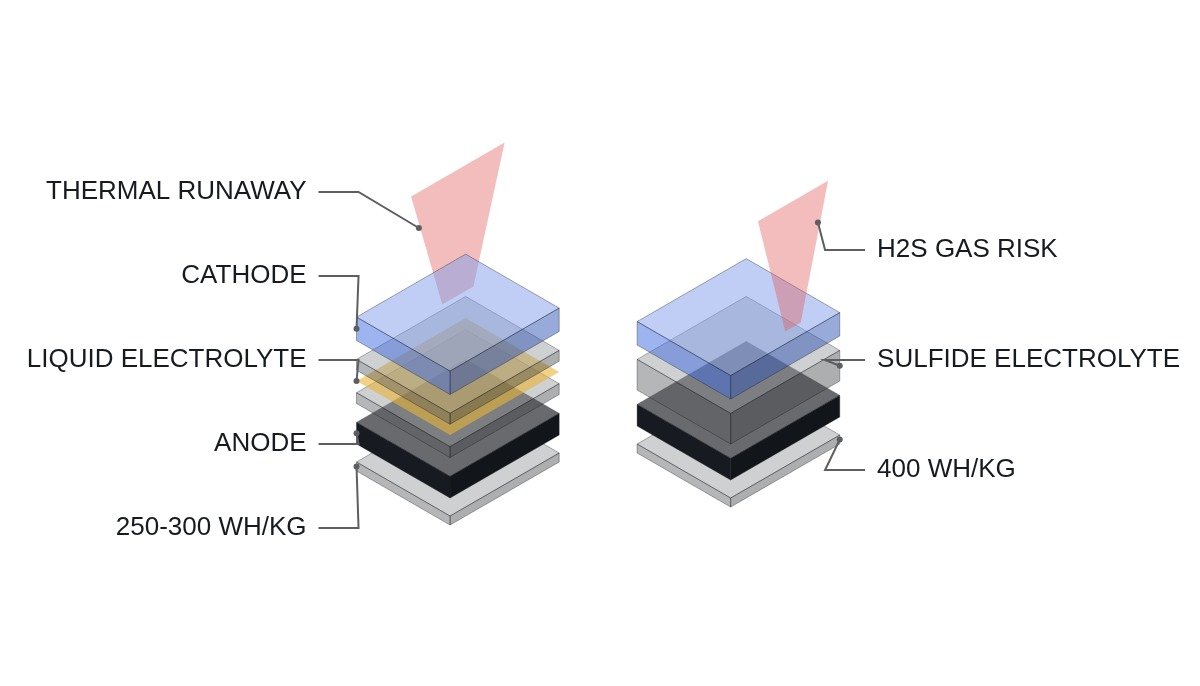
Today’s liquid-electrolyte lithium-ion batteries are bound by physical limits: an energy density of 250–300 Wh/kg and the risk of fire spreading once thermal runaway occurs. Applying a sulfide-based solid electrolyte raises energy density to the 400 Wh/kg class and also raises the ignition point, which leaves room to absorb a 3–5x cost premium in premium sedans and electric aircraft (eVTOL), where value per unit weight is high. Samsung SDI has signed a three-way agreement with BMW and Solid Power, applying Solid Power’s sulfide-based solid electrolyte to its cells and mounting them in a BMW test car for demonstration. The result can be seen as the commercialization verification stage of Samsung SDI’s solid electrolyte patent (US 12,278,333 B2).
Where it doesn’t — mass-market EV and ESS production
Mass-production cost is still 3–5 times that of lithium-ion, and the interfacial resistance between the solid electrolyte and the electrodes, as well as mechanical degradation from repeated charge and discharge, have not been fully solved. As long as these conditions hold, scale-up for mass production will be delayed, and mass-market commercialization of solid-state batteries is unlikely to arrive before 2029–2031. Meanwhile, semi-solid batteries in the 300–350 Wh/kg class are already being installed in some production vehicles in 2026, establishing semi-solid as the practical alternative in the mass-market segment.
Comparison table
| Item | Lithium-ion (liquid electrolyte) | Semi-solid | Solid-state (sulfide) |
|---|---|---|---|
| Energy density | 250–300 Wh/kg | 300–350 Wh/kg | 400 Wh/kg class (target) |
| Production cost (relative) | 1x (baseline) | 1.3–1.5x | 3–5x |
| Commercialization | In mass production | Some vehicles in 2026 | 2029–2031 |
| Key risk | Thermal runaway fire | Interface stability | Interfacial resistance, reaction with moisture |
| Representative case | All existing EV models | Some 2026 production EVs | Samsung SDI–BMW–Solid Power demonstration |
The takeaway from the table is clear. Solid-state has an undisputed lead in energy density, but until its cost curve bends, semi-solid serves as the practical bridge between lithium-ion and solid-state.
Reading the comparison from the system side
The comparison above is usually read as a contest of cell chemistries. From an electrical engineer’s point of view, it is more useful to read it as a question of where the value of the battery is judged. In a vehicle or aircraft, every kilogram carried has a cost in range or payload, so a gain in energy density pays back directly. In a stationary installation, the battery sits in a rack on a floor, and weight is rarely what decides the project; cost per stored unit of energy and service life are.
That is why the same cost premium can be acceptable in one application and unacceptable in another. The 3–5x production cost of solid-state is not a fixed disadvantage; it is a disadvantage only where the application does not pay for weight. For ESS, the energy density advantage of solid-state converts into little system-level value, while the cost premium applies in full.
The safety argument works the same way. A higher ignition point and the absence of flammable liquid electrolyte are real advantages at the cell level. But the safety of a battery system also depends on production conditions: as the boundary conditions below explain, a sulfide electrolyte that is exposed to moisture changes the risk picture. The safety advantage therefore belongs to the manufacturing process as much as to the chemistry.
Character comparison by application
| Aspect | Premium mobility / eVTOL | Mass-market EV | Stationary ESS |
|---|---|---|---|
| Main judging criterion | Value per unit weight | Cost and range balance | Cost per stored energy, life |
| Payback of energy density gain | Direct | Partial | Small |
| Tolerance for cost premium | High | Low | Low |
| Practical choice in the late 2020s | Solid-state candidate | Semi-solid or lithium-ion | Lithium-ion |
The table shows that the question “when does solid-state overtake lithium-ion” has no single answer. It overtakes first where weight is expensive, and last where weight is cheap. For ESS planning, solid-state news is a reason to watch the cost curve, not a reason to change the current design basis.
Order of judgment before adopting a new cell chemistry
- Identify what the application pays for: weight, volume, cost per stored energy or service life. This decides whether an energy density gain has value at all.
- Compare the cost premium against that value, using the relative cost figures in the comparison table as the starting point.
- Check the commercialization stage: demonstration in a test vehicle is not the same as mass production, and the design basis should follow what is in production.
- Check the specific risk of the chemistry in the production process (for sulfide electrolytes, moisture control) rather than assuming the cell-level safety advantage carries over automatically.
- Where a bridge option exists (semi-solid), evaluate it against both ends before committing to either.
Boundary conditions
Sulfide-based solid electrolytes can react with moisture in the air and release hydrogen sulfide (H2S) gas. If a production line fails to control its dry-room environment (dew point), the safety advantage of solid-state batteries can end up lower than that of lithium-ion. In that case, the conclusion of the comparison above is reversed. The selection criterion comes down to one question: does the value per unit weight offset both the cost premium and the dry-process risk at the same time?
References
- Samsung SDI signs three-way agreement with BMW and Solid Power – Kyunghyang Shinmun
- US 12,278,333 B2 — Samsung SDI solid electrolyte patent (Google Patents)
- Scientific American — The race to mass-produce solid-state batteries