I will state the conclusion first. Replacing an aging transformer takes high priority at facilities where the load factor constantly exceeds 80% of the rating. On the other hand, at a facility that has margin against its rating but sees peak load concentrated only in certain hours, load management (peak shifting, combined with ESS) should be considered before replacing the transformer. The transformer-related outages that occurred across Korea during the August 2026 heat wave are being reported with these two causes mixed together, so drawing conclusions about the cause without field measurement is something to be especially wary of right now.
1. Background — why the August 2026 outages are being reported as one story
During the August 2026 heat wave, a series of transformer-related outages was reported across Seoul and Gyeonggi Province. In Ilsan, Goyang, a vehicle crashed into a transformer and cut power to nearby households; in Yeongdeungpo-gu and Dongdaemun-gu in Seoul, outages were caused by a defective transformer and by an overloaded customer-owned transformer. In Dobong-gu, a transformer at an apartment complex exploded, cutting power to 526 households.
Lumping these cases together as “heat-wave overload outages” leads to the wrong judgment. External causes such as a vehicle collision and internal equipment causes such as aging and overload differ in both origin and response. Deciding on replacement or load management first, without separating the causes, is an approach with insufficient grounds at this point.
2. Where replacement wins — constant high load and aging equipment
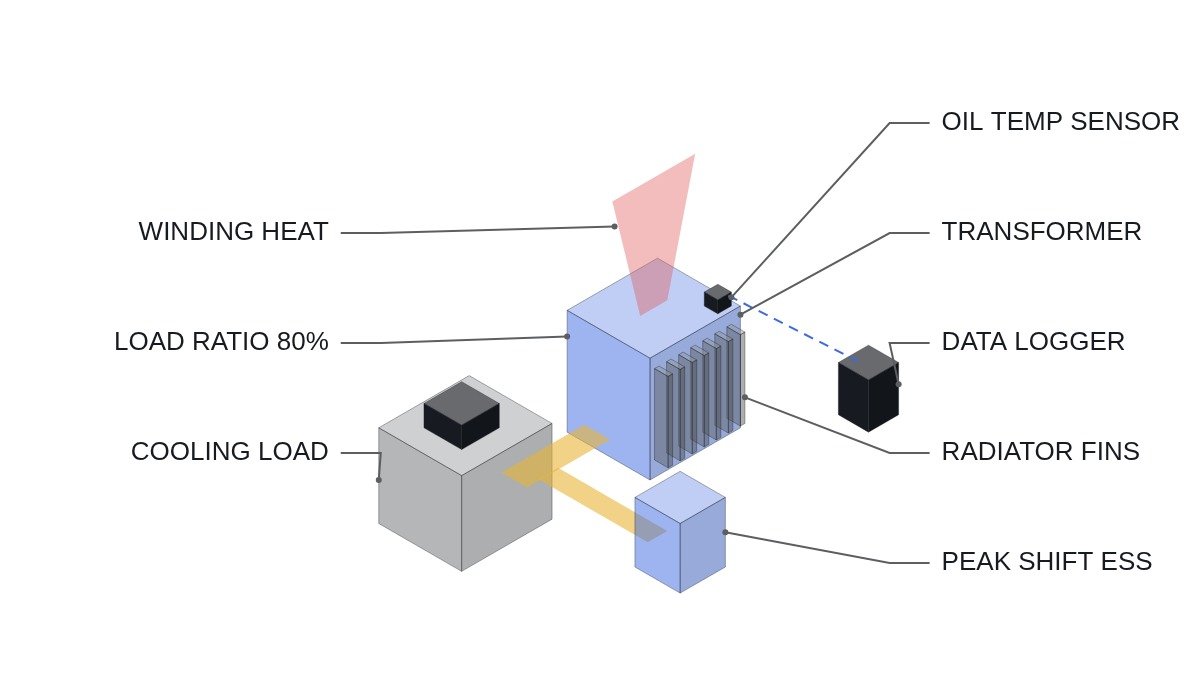
The current condition is this. If a transformer has been in service long enough for its insulating oil and windings to degrade, and its load factor hovers above 80% of rating even outside the heat-wave season, there is a constant risk that it will overheat and burn out the moment cooling margin shrinks in a heat wave.
Replacing the aging transformer changes things as follows. Applying a current insulation class and cooling method secures temperature-rise margin (thermal margin) on the same site under the same load conditions, and it also creates an opportunity to review protective relay settings against current standards.
Here is the linking logic. With the combination of constant high load and aging equipment, load management alone cannot remove the underlying risk, so deferring the replacement investment is more likely to lead to post-failure recovery costs and a loss of reliability.
3. Where it doesn’t — load management first: equipment with margin, peak-concentrated load
The opposite condition is just as clear. If the transformer itself is relatively new and has load-factor margin in normal times, but cooling load during the heat wave concentrates in specific hours (such as 2 p.m. to 6 p.m.) and momentarily approaches the rating, the core of the problem is the load pattern rather than the equipment.
Replacing the transformer first in this situation changes things as follows. The replacement cost is incurred, but the load concentration during peak hours remains, and the same phenomenon can recur in the next heat wave. Load management, such as combining with ESS or shifting cooling load (pre-cooling, spreading load across peak hours), is closer to a fundamental response.
4. Comparison table — by response strategy
| Item | Replacing the aging transformer | Load management (peak shifting, with ESS) |
|---|---|---|
| Suitable condition | Constant high load (above 80% of rating), aging equipment | Margin in normal times, peak-concentrated |
| Nature of investment | Equipment replacement (capital expenditure) | Operational improvement + ESS investment (phased) |
| When the effect appears | Immediately upon replacement | Takes time until the load profile improves |
| Recurrence prevention | Fundamental for aging and degradation problems | Fundamental for peak-concentration problems |
| Risk if the cause is misjudged | Limited effect if applied to a peak-concentrated case | Risk persists if applied to an aging/degradation case |
The row to focus on in this table is “Risk if the cause is misjudged.” If the cause is misidentified, either response only adds cost without solving the problem. Deciding on one side first without measured load-factor and temperature data is not recommended at this point.
5. Pre-heat-wave inspection checklist
- [ ] Confirm that the load-factor trend for the past year (monthly maximum and average) has been obtained from data-logger or EMS records
- [ ] Confirm that measured insulating-oil and winding temperatures of the transformer have been converted into margin against rating (thermal margin)
- [ ] Confirm with data whether the peak-load hours (e.g., 14:00–18:00) actually coincide with the load-factor peak — do not assume; measurement comes first
- [ ] Recheck against the manufacturer’s datasheet whether the service age and insulation class leave margin for the current load conditions
- [ ] Confirm that protective relay (overload and overtemperature) settings have been updated to reflect changes in the actual load profile (such as increased cooling load)
- [ ] When reviewing load management (peak shifting), confirm that the ESS discharge window is designed to coincide exactly with the measured peak hours
6. Boundary conditions and selection criterion
The point at which this judgment flips is clear. If load-factor measurement confirms constant high load and aging, replacement comes first; if concentration in peak hours is confirmed as the cause, load management comes first. Either way, setting an investment direction by attributing the cause from media reports alone, without measured data, lacks grounds at this point. The reasonable approach is to decide on a single criterion (whether the load factor exceeds 80%) after waveform analysis and field measurement.
References
- 1,200 households lose power in heat wave as transformer burden grows — Money Today (in Korean)
- Outage after vehicle hits transformer in Ilsan, Goyang — Nate News (in Korean)
- Transformers on alert during tropical nights — MBC News (in Korean)