The conclusion first. If the purpose is peak-load response with a discharge duration of 4 hours or less, solar-plus-ESS has already secured an LCOE (levelized cost of electricity) advantage over green hydrogen co-firing. Conversely, where seasonal storage or long-duration discharge of 10 hours or more is required, green hydrogen co-firing still does not drop off the list of candidates. From 2030 onward the gap is moving in the direction of widening, so the criterion for sequencing investment in PCS versus electrolysis equipment should follow this same split.
1. Background — why the LCOE gap is widening
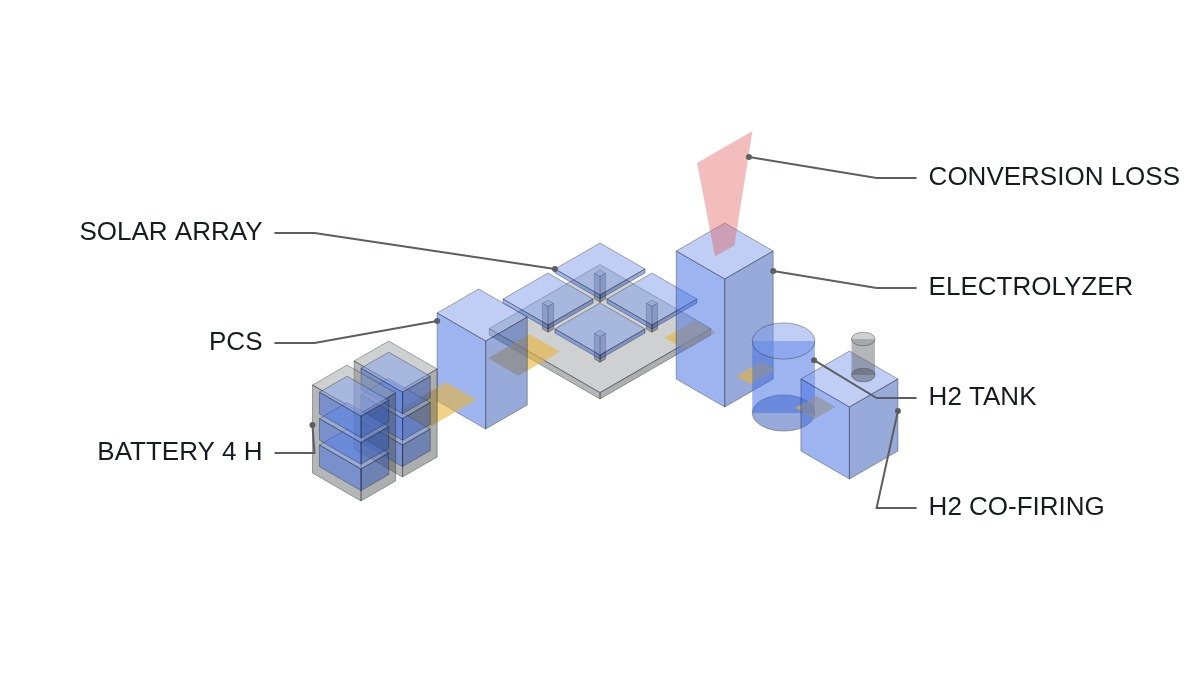
The cost of solar generation continues to fall. According to a domestic long-term outlook, solar LCOE is projected to drop from about 49 USD/MWh in 2024 to about 22 USD/MWh by 2050. Add falling battery prices, and the LCOE of combined solar-plus-ESS systems falls with it, while green hydrogen is held back by the capital cost of electrolysis equipment and the high production cost of green hydrogen itself.
An analysis comparing the LCOE of gas/green hydrogen co-firing with solar-plus-ESS systems found that gas/green hydrogen co-firing loses price competitiveness against solar-plus-ESS from 2030. Simplifying this trend into “green hydrogen is useless” leads to the wrong decision. The range where the gap widens is strictly the short- to mid-duration discharge range, and there is not yet enough basis to apply the same conclusion to long-duration storage.
2. Where it wins — peak-load response, discharge of 4 hours or less
The current condition is this. In grids where solar output concentrates in daytime and supply falls short during the evening peak, the job is to shave the peak with short-duration discharge. In that position, using battery prices that are already falling pays back capital faster than investing in new electrolysis and fuel cell stacks.
Applying solar-plus-ESS changes things as follows. PCS capacity is sized not on the instantaneous peak output of the solar array but on the discharge profile of the evening peak, and the number of battery racks is back-calculated from discharge duration (h) × required output (kW). Compared with green hydrogen co-firing, the equipment configuration becomes simpler, and permitting can avoid the regulations related to hydrogen storage and piping.
The connecting logic lies here. The shorter the discharge duration, the more directly the fall in battery investment cost per kWh translates into LCOE improvement, so in this range the advantage of solar-plus-ESS moves toward becoming more entrenched over time.
3. Where it doesn’t — long-duration storage and seasonal backup
The opposite condition is just as clear. In seasonal storage, where the winter shortfall in renewable output must be covered by summer surplus, or where long-duration discharge of 10 hours or more is required, the number of battery racks grows exponentially and capital cost rises sharply.
Covering such a position with solar-plus-ESS alone changes things as follows. As racks are added, battery room floor area, fire protection equipment and BMS I/O point counts all grow with them, and beyond a certain duration there remains room for hydrogen storage (green hydrogen production → storage → co-firing) to overtake on storage-medium cost.
That crossover point, however, depends on how fast the production cost of green hydrogen falls, and it is hard to pin down at present. Whether the policy direction (support for reducing green hydrogen production cost) leads to concrete price levels is something that needs continued monitoring.
4. Comparison table — by application perspective
| Item | Solar-plus-ESS | Green hydrogen co-firing |
|---|---|---|
| Suitable discharge range | Peak-load response of 4 hours or less | Candidate for long-duration and seasonal storage |
| LCOE trend as of 2026 | Continuing to fall (linked to battery price decline) | Competitiveness expected to weaken from 2030 |
| Main equipment | PCS, battery racks, BMS | Electrolysis equipment, storage tanks, co-firing plant |
| Permitting burden | Centered on ESS fire and electrical rules | Adds hydrogen storage and piping rules |
| Policy risk | Exposed to the trend of shrinking renewable subsidies | Dependent on policy support for green hydrogen production cost |
The row to watch in the table is “Policy risk.” The IEA’s 2026 analysis of world energy policy projected that, as fiscal pressure in many countries reduces direct subsidies for renewables, new global renewable capacity will decline by about 7% year on year for the first time since the 2000s. It should be noted alongside that solar-plus-ESS is not immune to this trend.
5. Checklist for equipment design
- [ ] First settle whether the required discharge duration (h) is above or below the 4-hour line
- [ ] Confirm that PCS capacity is sized on the peak discharge profile (kW·h), not on the instantaneous peak solar output
- [ ] Confirm that battery room area and fire protection equipment have margin for a rack-expansion scenario (the next 3–5 years)
- [ ] When reviewing green hydrogen in parallel, list the hydrogen storage and piping permitting items separately
- [ ] Include the risk of changes to renewable subsidy policy as a sensitivity item in the business case analysis (IRR)
- [ ] Do not draw conclusions on deviations in generation estimates caused by communication or metering errors — requires waveform analysis and field measurement
6. Boundary conditions and selection criterion
The point where this judgment flips is clear. Where the required discharge duration exceeds 10 hours or the purpose is seasonal backup, the cost-advantage logic of solar-plus-ESS does not carry over as-is. The rational standard at present is to choose solar-plus-ESS when the purpose is peak-load response, and to keep green hydrogen co-firing on the candidate list when the purpose is long-duration or seasonal storage. Make the final decision on the single criterion of discharge duration, while tracking policy-driven changes in green hydrogen production cost separately.
References
- Solar-plus-ESS vs gas/green hydrogen co-firing LCOE comparison — Today Energy
- Mid- to long-term LCOE outlook for expanded renewable supply — Korea Energy Economics Institute (KEEI)
- IEA 2026 World Energy Policy Report — Energy Safety News