The conclusion first. The 3rd ESS (energy storage system) central contract market tender is expected to be announced as early as September 2026 at a scale of 1GW (gigawatt) or more, and a reduction of the price weighting and the introduction of a price floor are being reviewed together. If the price weighting stays as it is, LFP (lithium iron phosphate) batteries, which can be supplied at low cost, have the advantage; if the weight of safety and certification evaluation grows, NCA (nickel cobalt aluminum) prismatic batteries backed by fire-propagation prevention technology and a domestic production system regain the advantage.
A 10-percentage-point cut in the price weighting alone flipped the top winning bidder from Samsung SDI to SK On — it is the design of the tender, not a gap in battery performance, that decides the outcome.
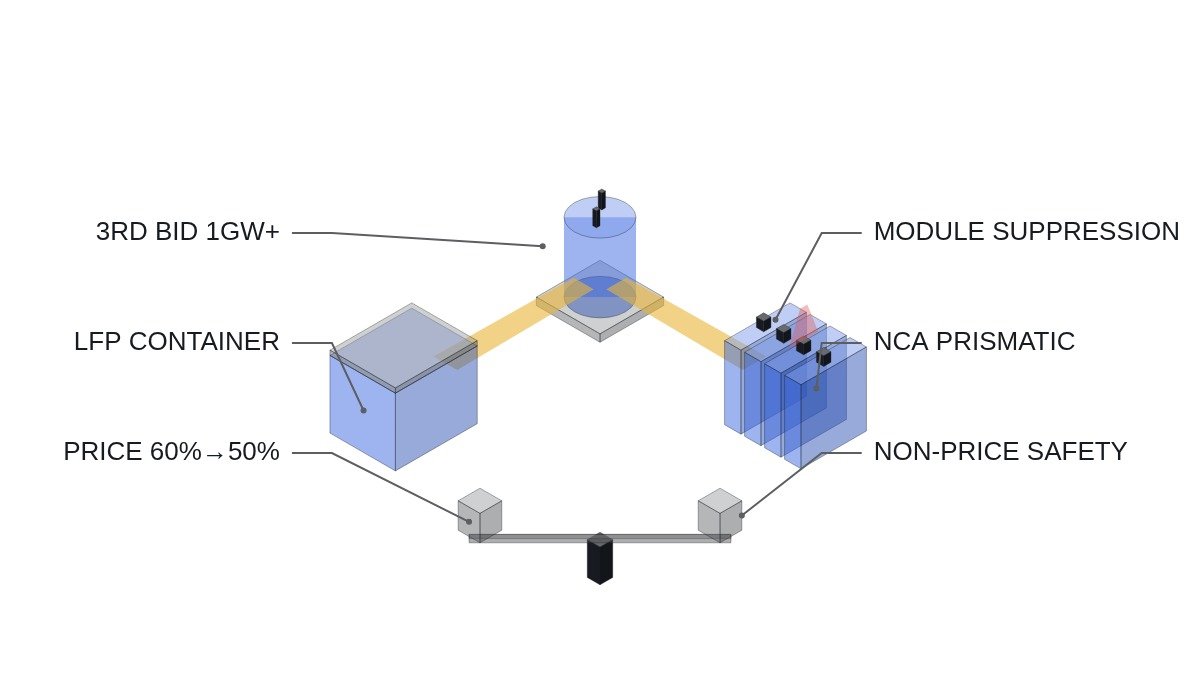
The Korea Power Exchange, under the Ministry of Climate, Energy and Environment, said as of August 26, 2026 that it is actively considering announcing the 3rd ESS central contract market tender at a scale of 1GW or more. Given that the 1st and 2nd tenders were about 560MW each, the volume would nearly double at minimum. The government plans to deploy a total of 23GW of ESS by 2038, investing about KRW 40 trillion over the period, and there are forecasts that while the 1st and 2nd tenders were each in the KRW 1 trillion range in project cost, the 3rd could reach the KRW 2 trillion range.
Where it wins — if non-price evaluation expands (NCA prismatic)
In the 1st tender held in July 2025 (560MW, price weighting 60%), Samsung SDI secured 75.8% (427MW) of the total volume, effectively dominating the round. Samsung SDI put forward NCA prismatic batteries produced at its Ulsan plant, offering higher energy density than LFP along with, as its safety case, its in-house fire-propagation prevention technology (EDI), which sprays extinguishing agent at the module level to block heat propagation to adjacent cells, and its record of passing UL9540A testing. If the weight of non-price evaluation items grows or a price floor is introduced in the 3rd tender, this certification and safety advantage is likely to decide the award again in the range where price alone does not differentiate bidders.
Where it doesn’t — if the price weighting holds (LFP)
In the 2nd tender in February 2026 (560MW, price weighting 50%), the picture flipped. SK On secured 50.3% (284MW) of the total with LFP batteries and became the largest supplier, while Samsung SDI took 35.8% (202MW) and LG Energy Solution 14.0% (79MW). According to industry estimates, the winning price, which was in the KRW 30s per kWh in the 1st tender, fell to the KRW 20s in the 2nd. Compared with the estimated bid price of the 2024 Jeju pilot project, which was in the KRW 50s per kWh, the decline is marked. LFP is known to cost about 80% of NCA, so as long as the price weighting is maintained, this structure is likely to repeat.
Comparison by tender round
| Round | Timing | Price weight | Top supplier | Share | Est. price (kWh) |
|---|---|---|---|---|---|
| 1st | 2025.07 | 60% | Samsung SDI (NCA prismatic) | 75.8% (427MW) | KRW 30s |
| 2nd | 2026.02 | 50% | SK On (LFP) | 50.3% (284MW) | KRW 20s |
| 3rd (expected) | Announcement expected 2026.09 | TBD (non-price expansion under review) | TBD | 1GW+ scale | TBD |
The takeaway from the table is clear. The volume allocation among the three battery makers flipped two rounds in a row not because cell performance changed abruptly, but as a result of the price weighting being adjusted by 10 percentage points, from 60% to 50%. Which direction this weighting moves in the 3rd tender will determine the award results.
Boundary conditions
Whether non-price evaluation will be expanded and whether a price floor will be introduced in the 3rd tender were, as of August 26, 2026, at the stage where the Ministry of Climate said it was “discussing volume and timing,” and neither has been finalized. How the scoring structure is actually announced remains a matter of estimation until publication. There is also a counterargument within the industry that introducing a price floor could be read as the government effectively acknowledging the weakening competitiveness of domestic battery makers. The selection criterion comes down to one question: at what percentage is the price weighting fixed in the 3rd tender notice?
References
Money Today, “Three battery makers go head to head in government‘s 3rd ESS tender… ‘an opportunity we can’t miss'” (2026.08.26)
Money Today, “[Exclusive] Government to expand ESS market sharply… 3rd tender likely 1GW or more” (2026.08.26)
Money Today, “The more ESS tenders you win, the deeper the loss?… K-battery makers bruised by cutthroat competition” (2026.08.26)
KR102050803B1, Changsung Ace Industry Co., Ltd., “Automatic fire extinguishing system for fire detection and spread prevention in energy storage systems (ESS)” (Google Patents)