To state the conclusion first: in the ultra-small, low-current segment (wearables), where minimizing ignition risk and freedom of form factor matter more than cost, oxide-based solid-state batteries already have the advantage, having reached the mass-production stage in the first half of 2026. In the high-current, large-area, high-capacity segment (EV and ESS), sulfide-based cells hold the energy density advantage, but interfacial resistance and moisture control issues mean they still do not surpass lithium-ion.
Early mass production of oxide-based cells for wearables is not a preview of early mass production of sulfide-based cells for EVs.
Where it wins — the wearable, ultra-small, low-current segment
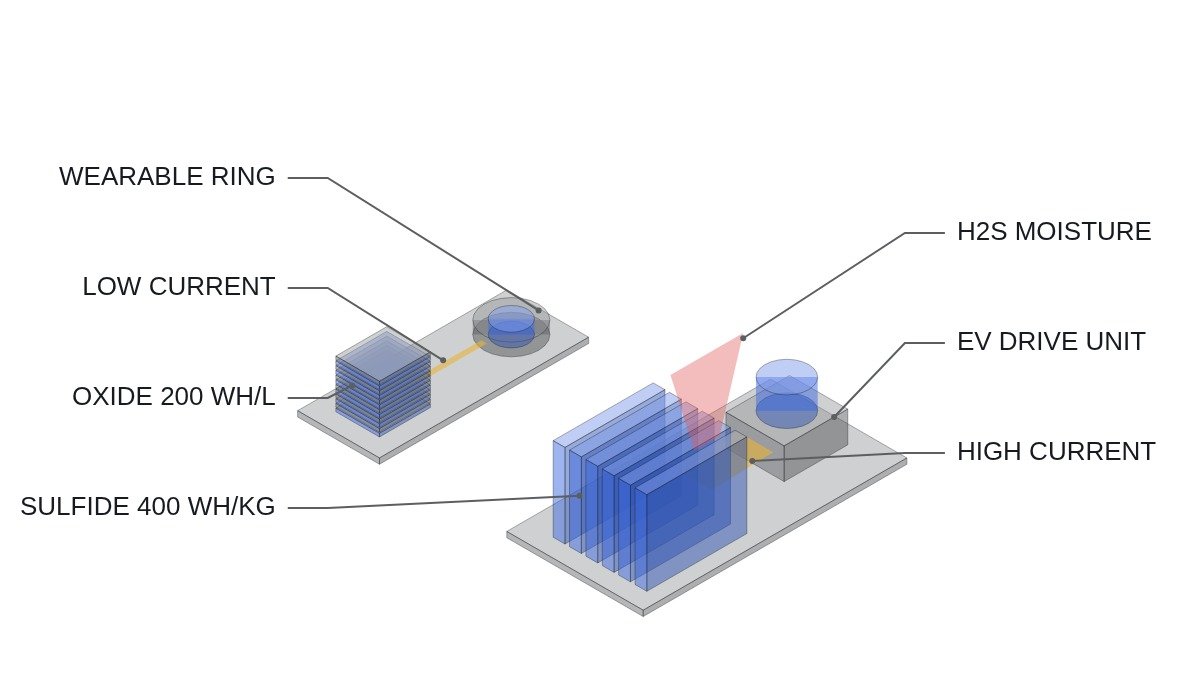
Samsung Electro-Mechanics developed the world’s first small oxide-based solid-state battery, is testing it with customers, and is targeting mass production in the first half of 2026. Its energy density is in the 200 Wh/L class, among the highest in the industry, and the company used its MLCC (multilayer ceramic capacitor) process know-how to secure freedom of form factor. Oxide-based materials are highly stable, easy to handle, and carry low explosion risk, so they are being applied first to low-current devices worn against the body, such as the Galaxy Ring, Watch, and Buds.
Where it doesn’t — the EV and ESS high-capacity, high-current segment
Oxide-based cells have high interfacial resistance between the electrode and the solid electrolyte, which puts them at a disadvantage for high-current discharge, and cracks form during the sintering process when large-area cells are made, which makes scale-up difficult. This segment belongs to sulfide-based cells — Samsung SDI has signed a three-way agreement with BMW and Solid Power and is running demonstrations of BMW test cars using a sulfide-based solid electrolyte, with a target energy density in the 400 Wh/kg class. However, sulfide-based materials can react with moisture in the air to generate hydrogen sulfide (H2S), so dry-environment (dew point) control on the mass-production line is essential.
Comparison table
| Item | Oxide (wearables) | Sulfide (EV) |
|---|---|---|
| Target current density | Low current (mA class) | High current (hundreds of A class) |
| Form factor | Ultra-small, MLCC-type stacking | Large-area pouch and prismatic |
| Energy density | Approx. 200 Wh/L | 400 Wh/kg class (target) |
| Main risks | Interfacial resistance, limits on high-current scale-up | Moisture reaction (H2S), interfacial stability |
| Mass production | H1 2026 (wearables) | 2029-2031 (general EV use) |
| Representative case | Samsung Electro-Mechanics small oxide cell | Samsung SDI-BMW-Solid Power demonstration |
The implication of this table is clear. 200 Wh/L (volume basis) and the 400 Wh/kg class (mass basis) are measured on different bases and cannot be compared directly, and placing the two material paths on a single “solid-state battery commercialization roadmap” line and ranking them in order is a misreading.
Reading the two tracks from the equipment side
The current density row is the one that separates the two tracks, and it maps directly onto how each cell is used in a system. A wearable draws mA-class current from a cell that sits against the skin; the design priorities are that the cell cannot ignite, cannot leak, and can take whatever shape the housing allows. A traction or stationary pack draws hundreds of A from many cells in series and parallel; the design priorities are energy per unit mass, power delivery, and the manufacturability of large cells at volume.
Seen that way, the weaknesses listed in the table are not defects of one track versus the other. The interfacial resistance of oxide cells barely matters at mA-class current, and becomes decisive at hundreds of A. The moisture sensitivity of sulfide cells is not a field-use problem first but a production-line problem: dew point control of the dry environment becomes a facility requirement, with its own ventilation, monitoring, and H2S detection considerations on the line.
This is also why the mass-production dates in the table should not be read as a single schedule. The first half of 2026 for wearables and 2029-2031 for general EV use are milestones on two separate tracks, each gated by its own constraint: form factor and safety in one case, interfacial stability and moisture control at scale in the other.
Character comparison by application requirement
| Requirement | Oxide track | Sulfide track |
|---|---|---|
| Ignition risk near body | Strong fit | Not the design target |
| Free form factor | Strong fit | Limited |
| High-current discharge | Weak | Design target |
| Large-area scale-up | Sintering cracks | Design target |
| Line environment control | Easier handling | Dew point control essential |
What this table shows is that each track fits the requirement set it was designed for and struggles outside it. A procurement or design review should therefore start from the load requirement and pick the track, rather than start from a commercialization headline and assume it applies to every application.
Decision order
- Define the load current the cell must deliver: mA class or A class.
- Check whether the cell will sit against a person or inside a confined consumer housing, where ignition risk and form factor dominate.
- Confirm which energy density basis the application cares about: volume (Wh/L) or mass (Wh/kg), and compare only like with like.
- For the sulfide track, confirm the supplier’s dry-environment (dew point) control and H2S handling on the production line.
- Read mass-production dates as track-specific milestones, not as a shared roadmap.
Boundary conditions
The 200 Wh/L figure presented by Samsung Electro-Mechanics is volumetric energy density, while the 400 Wh/kg class commonly used in the EV industry is gravimetric energy density. Comparing two metrics with different bulk density (mass per volume) on the same line and concluding that “oxide-based cells are technically behind” is an error. In addition, the high-current scale-up limit of oxide cells may be eased by improvements in the sintering process, so it is difficult to reach a firm conclusion on current evidence — requires waveform analysis and field measurement. The selection criterion condenses to one question: is the target load current density in the mA class or the A class?
References
- Samsung Electro-Mechanics Newsroom, “Samsung Electro-Mechanics develops the world’s first solid-state battery for wearables”
- Asia Economy, “Samsung Electro-Mechanics develops world’s first small solid-state ‘dream battery’… mass production in 2026”
- US20210119248A1 — Samsung Electro-Mechanics, All solid battery (Google Patents)