Bottom line first. Lithium-metal and lithium-sulfur batteries both push gravimetric energy density (Wh/kg) upward, and both pay for it in at least one of cycle life, volumetric energy density and power. The first place these cells overtake lithium-ion is therefore applications where each kilogram directly sets operating time or payload, and where the required cycle count is low: unmanned aircraft, high-altitude platforms and air mobility. ESS, where thousands of cycles, cost and safety come first, and passenger EVs, which need both volume efficiency and long life, come later.
Where it wins, where it doesn’t
Current condition
Commercial lithium-ion cells use graphite anodes. Graphite is a host structure that stores lithium between its layers, so volume change during cycling is small and cycle life is long. Its theoretical specific capacity, however, is 372mAh/g, which limits how far the anode’s share of cell weight can be reduced. The next-generation cell debate is about where to break that limit.
After the change
A lithium-metal anode uses lithium metal itself with no host, with a theoretical specific capacity of 3,860mAh/g, roughly ten times that of graphite. Lithium-sulfur goes further and replaces the cathode active material with sulfur, whose theoretical specific capacity of 1,675mAh/g is far above conventional metal-oxide cathodes. Both technologies aim to store much more charge per unit of cell weight.
Connecting logic
The problem is the distance between theory and real cells. In lithium-metal cells, lithium does not plate evenly during charge but grows as dendrites, causing shorts and capacity loss; with no host, thickness changes a lot during cycling, so the cell must be held under steady pressure. In lithium-sulfur cells, polysulfides formed mid-discharge dissolve into the electrolyte and shuttle between cathode and anode, draining capacity; and because sulfur is an electrical insulator, the cell needs a lot of conductive additive and electrolyte, which cuts real-cell energy density well below theory. These weaknesses show up as cycle life and volumetric density, so the advantage holds only where the weight gain outweighs the losses in life and volume.
Cell technology comparison
| Item | Li-ion (graphite) | Lithium-metal | Lithium-sulfur |
|---|---|---|---|
| Anode | Graphite host | Lithium metal | Lithium metal (mostly) |
| Cathode | Metal oxide or phosphate | Metal oxide | Sulfur-carbon composite |
| Gravimetric density | Baseline | Higher | Higher |
| Volumetric density | Baseline | Higher | Tends to be worse |
| Cycle life | Long | Tends to be short | Tends to be short |
| Stack pressure | Low requirement | Required | Design dependent |
| Main degradation | SEI growth, lithium loss | Dendrites, uneven plating | Polysulfide shuttle |
| Average discharge voltage | Baseline | Similar, cathode dependent | Lower |
The one row both next-generation cells win is gravimetric energy density; several others are losses or come with conditions. Lithium-sulfur is further disadvantaged on volume and voltage. The application decision is therefore not “which cell is better” but “how much can this application give up on everything except weight”.
How the gain dilutes at pack level
A cell’s Wh/kg gain does not carry through to the pack unchanged, because the pack also contains non-cell mass: enclosure, cooling, BMS and wiring. Assumptions: pack energy 100kWh, baseline cell 250Wh/kg, cells at 70% of pack mass, non-cell mass fixed regardless of cell change.
| Cell Wh/kg (assumed) | Cell mass | Pack mass | Pack Wh/kg |
|---|---|---|---|
| 250 | 400kg | 571kg | 175 |
| 375 (+50%) | 267kg | 438kg | 228 (+30%) |
| 500 (+100%) | 200kg | 371kg | 269 (+54%) |
The 171kg of non-cell mass is 571kg x 30%. A 50% gain in cell energy density becomes about 30% at pack level, and doubling it yields about 54%. The larger the non-cell mass fraction, as in small packs, the more the cell gain is diluted. Adding structure to maintain cell stack pressure increases non-cell mass and dilutes the gain further.
The electrical side brings another variable. Lower average cell voltage means more cells in series to reach the same pack voltage, and BMS voltage channels grow with the series count. Assumptions: 400V pack, average cell voltages of 3.6V versus 2.1V, giving series counts of about 111 and about 190. Adopting lithium-sulfur means monitoring electronics and wiring grow accordingly, which must be reflected early in design.
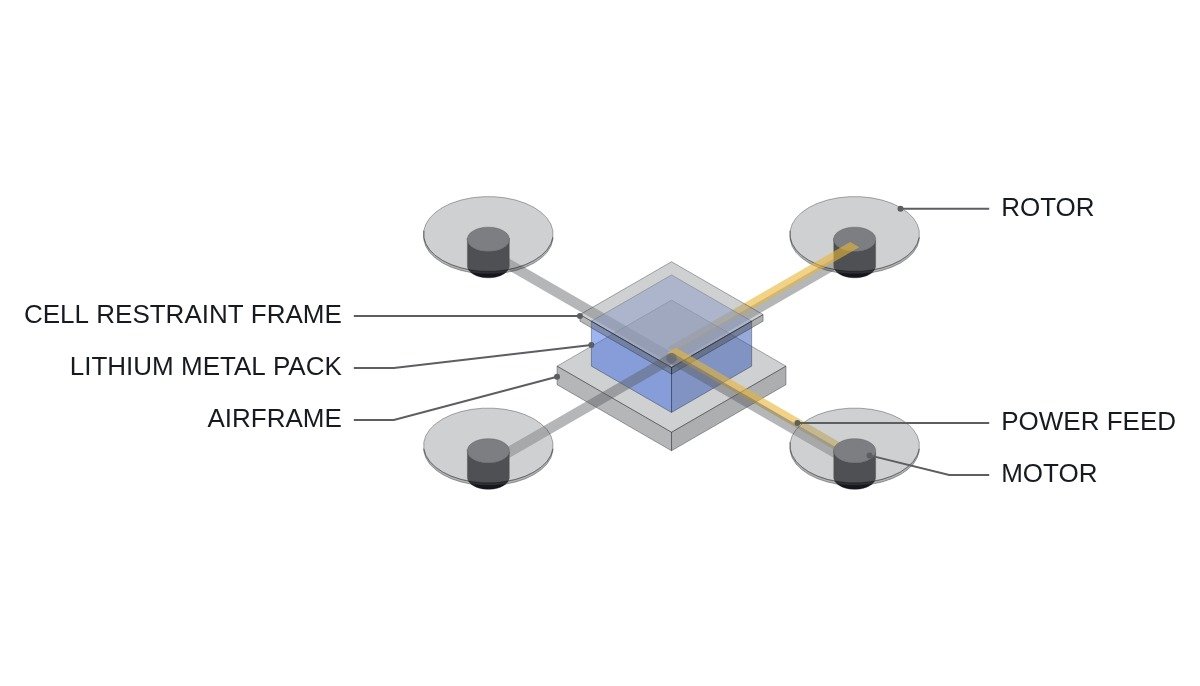
Even so, there is a reason the weight gain is felt so strongly in aircraft. A ground vehicle whose battery gets lighter sheds only part of its rolling and aerodynamic resistance, but an aircraft in the air must hold its entire weight up with thrust. In momentum theory, ideal hover power is proportional to thrust to the power of 1.5. A lighter battery reduces both required thrust and power consumption, so the same energy keeps the aircraft aloft longer. Applications where the weight gain is amplified a second time through lower power consumption are why next-generation cells find their first home there.
Items to check
- □ Required cycle count and replacement interval. Can replacement be built into operations?
- □ Installed volume constraint. If volume is the bottleneck, lithium-sulfur’s advantage can reverse.
- □ Stack pressure requirement and the mass of the structure to provide it. Recalculate Wh/kg at pack level.
- □ Average cell voltage, the resulting series count, and the added BMS channels.
- □ Transport and safety test requirements (UN 38.3 transport testing and the certification regime for the application). New cell chemistries have short certification histories, which adds schedule risk.
- □ Items to verify: measured cycle life of candidate cells and the conditions (temperature, discharge rate, stack pressure). Published figures use different test conditions and are not compared directly.
The first item to answer is the first on the list. If the application needs only a few hundred cycles, the short life of next-generation cells is not fatal; if it needs thousands, lithium-ion remains without reviewing the rest. Life requirement acts as the first-pass filter.
Boundary conditions
This judgment changes under the following conditions. First, if lithium-metal anodes paired with solid electrolytes solve cycle life and safety, the volumetric benefit brings passenger EVs into range as an application. Second, if lithium-sulfur techniques that reduce electrolyte quantity are proven at real-cell level, the weight gain grows and the range of applications widens. Third, conversely, the moment an application ranks cost above weight, both technologies lose to lithium-ion and its long mass-production history.
Fourth, stack pressure requirements move the boundary. Lithium-metal cells often need a steady surface pressure to operate stably, and the structure that holds that pressure to end of life adds pack mass and volume. This is exactly where the fixed non-cell-mass assumption in the dilution calculation breaks. If the restraint structure is heavy, the pack-level Wh/kg gain shrinks sharply, and a choice that looked good on the cell datasheet can reverse at pack level. The required pressure and restraint mass are items to verify for each candidate cell.
The single selection rule: lithium-metal or lithium-sulfur wins only in applications where the weight gain, recalculated at pack level, exceeds the replacement cost from shorter cycle life and the volume penalty; otherwise lithium-ion wins.