When people hear “power system,” it’s easy to picture a single generator, but in reality it is one continuous chain of generation, conversion, storage, and distribution. Looking at any single stage alone cannot tell you the overall efficiency.
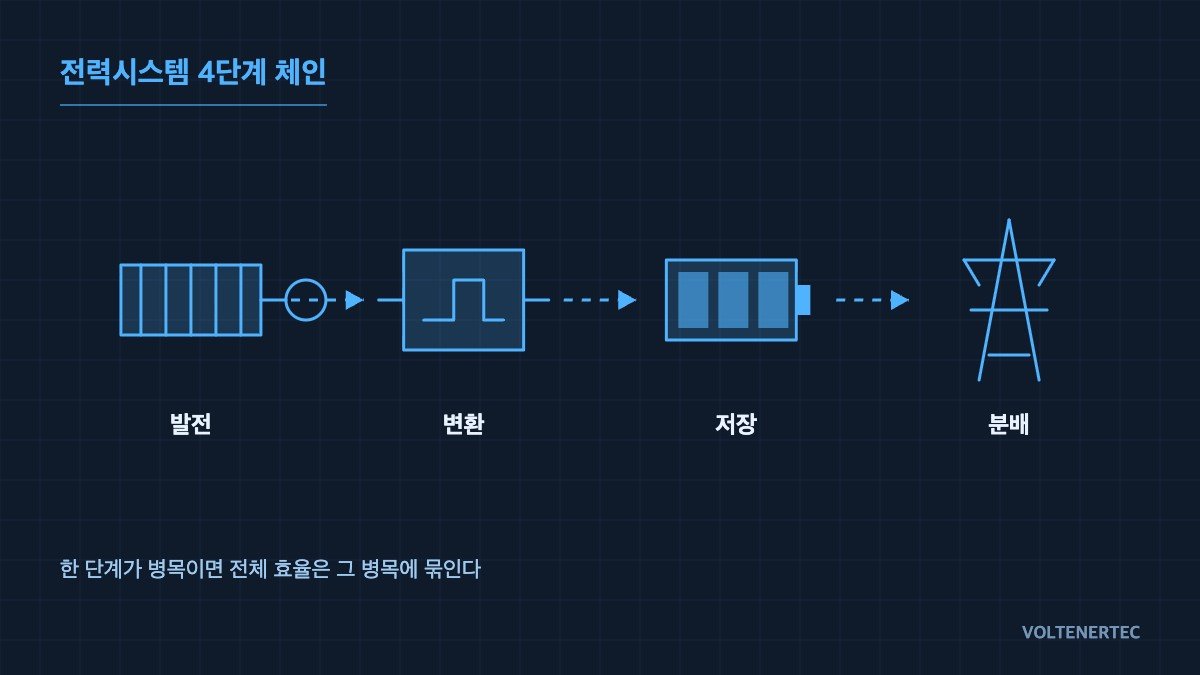
The Four Stages of a Power System
| Stage | Role |
|---|---|
| Generation | Converts primary energy (solar, fossil fuels, etc.) into electricity |
| Conversion | Matches voltage/frequency to grid specifications (PCS, transformers) |
| Storage | Absorbs the time gap between generation and consumption (ESS, etc.) |
| Distribution | Delivers power to the actual point of demand (transmission/distribution network) |
Implication: the four stages have different roles, but power always passes through them in this order. A loss or stoppage at any stage is carried straight into every stage after it, and spare margin in an earlier stage cannot make up for a shortfall in a later one.
Why You Must Look at the Whole Chain
No matter how high generation efficiency is, if losses are large at the conversion or distribution stage, the power ultimately usable is reduced. Especially when generation and consumption timing diverge, as with renewable energy, the design of the storage stage determines the overall system efficiency.
How an electrical engineer reads the chain
The same structure appears in equipment panel design. On the path from incoming supply through the breaker, transformer and servo drive to the motor, a better motor does not help if the breaker capacity or drive rating is short; the machine stops at that limit. The four stages of a power system can be read as a series path in the same way. In a series path overall performance is set by the product of the stages, not their sum, and the weakest section sets the ceiling.
One more criterion follows. It is not only efficiency that multiplies down along the chain; availability does too. If any one of the four stages stops, no power reaches the load even while the generator runs. A chain assessment therefore needs, alongside the efficiency figures, a stoppage-impact table that shows what stops when each stage stops.
Conversion equipment is often selected with rating margin, so it does not look like a bottleneck in normal operation. The bottleneck shows up when load peaks or when one stage stops. The chain should therefore be checked against peak-load and fault conditions, not average operating data.
Character comparison by stage
| Stage | Nature of loss | Impact if it stops | Check in design |
|---|---|---|---|
| Generation | Primary energy conversion loss | Source itself lost | Output swing and predictability |
| Conversion | Switching and transformer loss | Cannot connect to grid specification | Rating margin and protection coordination |
| Storage | Charge/discharge round-trip loss | Timing gap no longer absorbed | Gap to absorb and charge/discharge conditions |
| Distribution | Line loss | Power cannot reach the load | Line capacity and relay coordination |
Implication: generation is the only stage that produces energy; the other three each lose a little. Every added stage lowers efficiency, so the design question is whether the function gained in return (grid compliance, gap absorption, delivery) is worth the loss.
Where a storage stage wins, where it doesn’t
Where it wins. Current condition: generation and consumption are offset in time, as with renewables. After applying it: the storage stage takes surplus power and releases it when demand arrives. Connecting logic: without storage the offset generation goes unused, so even after round-trip loss the usable power across the chain increases.
Where it doesn’t. Current condition: generation and consumption already move together. After applying it: every unit of power routed through storage picks up charge/discharge loss and an extra conversion stage. Connecting logic: with no gap to absorb, inserting storage only lengthens the chain and adds loss.
Chain check sequence
- Check safety interlocks and protection coordination first. Confirm that breakers and protective relays at each stage isolate only the faulted section, and that the emergency stop circuit is built in hardware.
- List losses per stage on the same basis (kW or kWh). The values are items to verify per equipment.
- Mark the weakest section: the stage with the least rating margin and the stage with the most stoppage history.
- Judge the need for storage by the timing gap. Confirm from the load profile that a real time difference between generation and consumption exists.
- Check signal and communication links between stages. Do not assign a cause to communication errors between converter, storage and supervisory system; they require waveform analysis and field measurement.
Summary
A power system must be evaluated as the combination of all four stages, not by generator performance alone. The bottleneck always occurs at the weakest link.
Boundary conditions
The whole-chain principle weakens in some cases. In a small stand-alone installation where the generator feeds the load directly and conversion, storage and distribution are practically absent, the chain shrinks to generation alone and generator performance becomes system performance. And if one stage has losses or stoppages far larger than the others, there is no need to weigh all four evenly; fixing that one section comes first. The single criterion is this: find the stage that reaches its limit first on the path to the load, and assign design resources to that stage first.
Related reading (Korean) — Industrial UPS — Power System Basics for Outage Response