To give the conclusion first: once the amended enforcement decree takes effect on September 18, solar setback regulation becomes more favorable for developers only in areas where existing local ordinances set setbacks above 200m. Local governments already operating at around 100–150m are unaffected by the new national cap. From an electrical engineer’s standpoint, the real variable is not the setback relaxation itself but how far forward the design of the point of interconnection (POI) can be moved on a site that has been secured.
1. Where it wins — areas whose ordinances were stricter than the national cap
Current condition: Of Korea’s 228 basic local governments, 129 operate solar setback distances through their own ordinances, with wide regional variation from 100 to 1000m. In areas applying ordinances of 300m or more, setback regulation itself was the permitting bottleneck at the site-securing stage.
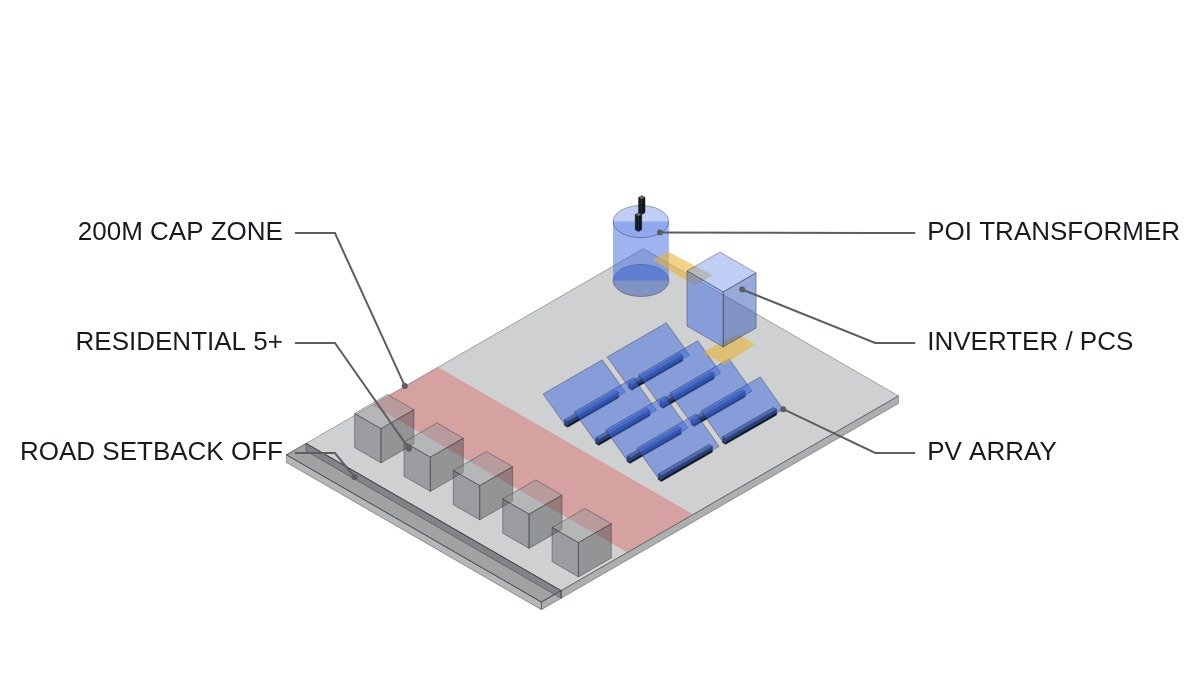
Change after application: Under the amendment to the “Enforcement Decree of the Act on the Promotion of the Development, Use and Diffusion of New and Renewable Energy,” approved by the Ministry of Climate, Energy and Environment at the Cabinet meeting on August 11, 2026, the cap on setbacks from residential areas (based on 5 or more houses) is fixed at 200m (effective September 18, 2026). Local governments that applied 300m, 500m or 1000m ordinances must lower them to within 200m before the effective date, and setback rules based on roads are abolished nationwide.
Connecting logic: As potential site area increases, developers who have already worked through inverter and PCS placement and the point-of-interconnection review can file for permits as soon as the ordinances are amended. Conversely, if electrical design only starts after the site is secured, this round of relaxation is missed entirely.
2. Where it doesn’t — areas already within 200m, or with no grid headroom
Local governments that have applied 100m or 150m ordinances are unaffected by this amendment. Also, even if setbacks are relaxed, grid interconnection itself is impossible if the distribution lines and substations in the area have no spare capacity. That has to be confirmed separately, not through local ordinances but through KEPCO’s grid interconnection review — judging spare distribution capacity requires waveform analysis and field measurement.
3. Comparison table
| Category | Before (local ordinances) | Amended (national cap, from 9/18) |
|---|---|---|
| Solar setback from residential areas | 100–1000m (varies by region) | Up to 200m |
| Setback from roads | Regional rules (up to 100m considered) | Abolished nationwide |
| Permitting predictability | Low (differs by local government) | High (uniform national cap) |
| Wind setback (reference) | 100–2000m | Caps of 1500m residential, 500m road |
Implication: As the table shows, the real benefit of this amendment lies not in shorter setbacks as such but in greater permitting predictability from a uniform cap. For developers, the correct first step is to check the current ordinance value of the local government where each candidate site is located before September 18.
4. Boundary conditions — when this relaxation flips
Under the following conditions, the advantage of introducing the national setback cap disappears. First, when the local government of the candidate site already operates a 100–150m ordinance. Second, when the setback is satisfied but spare capacity at nearby substations and distribution lines is exhausted, so the project has to wait for interconnection. Third, when the local government delays amending its ordinance until the effective date (9/18), so the existing regulation stays in place temporarily. The final criterion is not whether setback regulation has been relaxed, but whether confirmation of grid interconnection headroom came first.
References
- Ministry of Climate, Energy and Environment, partial amendment to the “Enforcement Decree of the Act on the Promotion of the Development, Use and Diffusion of New and Renewable Energy” approved by the Cabinet, 2026-08-11
- Electronic Times (Etnews), “Government pins solar setback cap at 200m… expanding generation sites”, 2026-08-11
- Patent: US20150331972A1 (HST Solar Farms Inc, “System & methods for solar photovoltaic array engineering”, published 2015-11-19) — patent application on automatically recalculating solar array layout and electrical design when site conditions change