To state the conclusion first: in immersion-cooled ESS, the coolant itself serves as both the insulating and the heat-transfer medium, so interlock priority has to be designed differently from air-cooled systems — the coolant circulation and level interlocks must sit above the cell temperature interlock. G2Power’s AI immersion-cooled ESS, unveiled at the company’s new product and technology presentation held at its headquarters in Hwaseong, Gyeonggi Province, on August 26, 2026, reflects this principle in its control logic; the company said it keeps the temperature difference between battery cells at 3℃ or less and extends battery life by about 20% compared with air cooling.
At the event, G2Power demonstrated the new product, which applies an immersion-type battery management system (BMS), AI-based battery degradation prediction and active temperature control, heat exchanger control, energy management system (EMS) and power management system (PMS) monitoring, and condition monitoring and diagnostics (CMD) technology. The company said the product was certified at 0.5C-rate and that tests confirmed potential use up to 1.0C-rate, and it is preparing UL9540 certification to enter North America. Using this case as a starting point, this article sets out the safety interlock order and I/O checklist to check first when introducing an immersion-cooled ESS.
Precondition: because the exact operating sequence of any individual site was not provided, the checklist below is developed on the basis of the general start-up time chart of an immersion-type ESS module using insulating cooling oil. In actual application, it must be replaced and verified against the time chart in the equipment manufacturer’s specification.
Safety interlock check order (top priority)
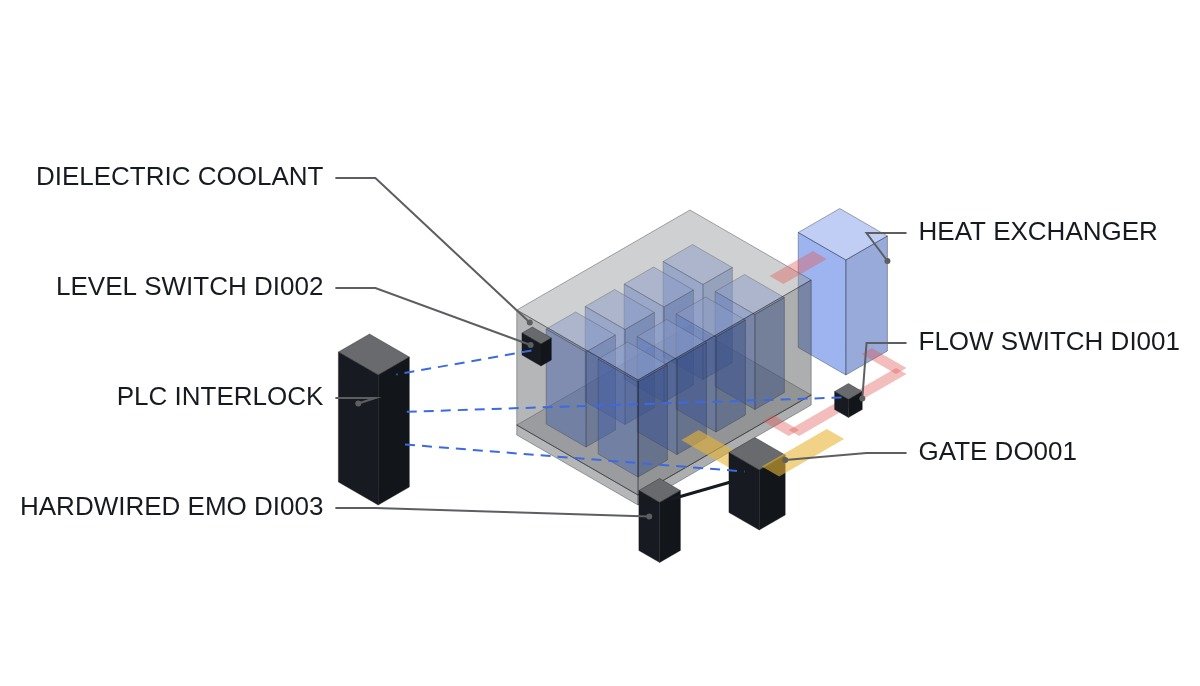
- Coolant circulation and flow interlock — on detecting a circulation pump stop or low flow, block the charge/discharge gate immediately (an item that does not exist in air-cooled systems)
- Coolant level and leak interlock — a drop in insulating oil level leads to cell exposure and reduced insulation resistance, with a risk of ground faults, so block immediately
- Cell temperature deviation interlock — alarm when the deviation exceeds the threshold, and pre-emptive cooling or blocking based on AI degradation prediction (management target 3℃ or less)
- Grid-side electrical interlocks — undervoltage (UVR), overvoltage (OVR), overcurrent, and frequency abnormality
- EMO (Emergency Off) — the principle is a hardwired configuration that directly cuts the charge/discharge gate signal; designs that replace or bypass the EMO function with software logic alone are not covered on this site.
Grid connection and charge/discharge start-up sequence checklist (I/O map)
| Signal | I/O address | Type | Operating condition |
|---|---|---|---|
| Coolant flow switch | DI001 | Digital In | 0 = normal, 1 = low-flow alarm → block charge/discharge gate immediately |
| Coolant level switch | DI002 | Digital In | 0 = normal, 1 = low level → block immediately and alarm |
| EMO pressed status | DI003 | Digital In (hardwired) | 1 = pressed → cannot be bypassed by PLC, gate cut directly |
| Cell temperature deviation | AI001 | Analog In 4-20mA | 0-20℃, alarm at 5℃ or more, management target 3℃ or less |
| Coolant temperature | AI002 | Analog In 4-20mA | 0-60℃, de-rating at 45℃ or more |
| Charge/discharge gate enable | DO001 | Digital Out | Outputs 1 only when all interlocks are normal |
This checklist is itself the set of field execution items. In particular, DI001 (flow) and DI002 (level) are items unique to immersion cooling that do not appear in an air-cooled ESS checklist, and they must have hardware priority independent of the PLC scan cycle.
PLC logic snippet (IEC 61131-3 Structured Text pseudocode)
(* Immersion-cooled ESS charge/discharge gate enable logic *)
(* DI001: coolant low flow, DI002: coolant low level, DI003: EMO hardwired *)
IF DI001 = 1 THEN
    DO001 := FALSE; (* Low-flow alarm: highest-priority block, ms-level response required *)
ELSIF DI002 = 1 THEN
    DO001 := FALSE; (* Coolant low level, risk of reduced insulation resistance *)
ELSIF DI003 = 1 THEN
    DO001 := FALSE; (* EMO cuts directly in hardware by principle; this line is for status display *)
ELSIF AI001 > 50 THEN (* 5.0℃, 0.1℃ resolution *)
    DO001 := FALSE; (* Excessive cell temperature deviation *)
ELSE
    DO001 := TRUE; (* Enable gate only when all conditions are normal *)
END_IF;
Boundary conditions — handling field variables
The trend of decreasing insulation resistance due to long-term degradation (oxidation) of the cooling oil varies by oil type and operating conditions and is hard to state uniformly, so it is reserved as requiring waveform analysis and field measurement. In addition, immersion cooling carries a higher initial CAPEX and a maintenance-access burden compared with air cooling, so air cooling may still be advantageous for small-capacity, short-term projects. The final selection criterion is: “Do the total cost of ownership (TCO) savings exceed the increase in initial CAPEX plus the added maintenance complexity?”
References: Newspim, “G2Power targets AI data centers with ‘immersion-cooled ESS’… preparing to enter North American market” (2026-08-26) / GS Caltex Media Hub, “Immersion cooling opens the future of high-heat electronic equipment” / US12,148,946 B2, Immersion cooling system for battery systems of electric vehicles (preventing vent gas from heating adjacent cells by separating cell groups)