To state the conclusion first: biomass power is almost the only renewable source that buys its fuel and burns it. Its economics therefore look more like a thermal plant than like solar or wind, and the project succeeds or fails on the fuel contract before the boiler or turbine. The advantages are real: it is dispatchable, and its synchronous generator provides grid inertia. But the operator carries every fuel risk, price, volume, quality (moisture content), transport, and storage, plus policy-change risk. The decision criterion is not plant efficiency but whether the fuel for the plant’s whole life can be secured in energy units.
Where It Wins, Where It Doesn’t
Under current conditions, solar and wind have no fuel cost but their output cannot be set by anyone. The grid operator must back up the varying output with other sources, and for the generator, weather is revenue. The very idea of fuel procurement does not exist.
Apply biomass and the conditions reverse. As long as fuel is stockpiled, the plant can generate the output it wants when it wants, and the synchronous generator supplies inertia and reactive power to the grid. If there is heat demand nearby, it can run as combined heat and power and sell heat as well. In exchange, fuel cost comes off revenue, and if fuel prices spike or supply stops, the plant halts even with healthy equipment.
The connecting logic is this. Biomass is equipment that trades weather risk for supply-chain risk. Its evaluation method should therefore come from thermal generation (fuel contract terms, fuel-cost pass-through, inventory management), not from renewables (resource and capacity factor). That is why the fuel procurement review has to finish before the equipment investment review.
The weight of the risk also depends on the plant type. Co-firing, blending some biomass into an existing coal boiler, can hold output on the main fuel if biomass supply wavers, so operating risk is small, but the renewable share and its recognition are limited. A dedicated biomass plant has a clear renewable share, but any fuel supply disruption becomes a shutdown. With the same fuel contract, the supply-interruption clause weighs far more heavily on a dedicated plant.
Moisture Content — What a Per-Tonne Contract Hides
The heating value of biomass fuel depends heavily on moisture. The wet-basis lower heating value is approximated as LHV_wet = LHV_dry × (1 − w) − 2.44 × w (MJ/kg), where w is wet-basis moisture content and 2.44 MJ/kg approximates the latent heat needed to evaporate the water.
Assumption: dry-basis lower heating value LHV_dry = 19 MJ/kg. At 10% moisture, 19 × 0.9 − 2.44 × 0.1 = 16.86 MJ/kg; at 40% moisture, 19 × 0.6 − 2.44 × 0.4 = 10.42 MJ/kg. The energy in one tonne drops by about 38%. To produce the same energy (MWh), 40%-moisture fuel needs 16.86 / 10.42 ≈ 1.62 times the mass of 10% fuel, and truck trips and storage space rise by the same ratio.
A practical judgment follows. Contracting fuel by the tonne can mean paying fuel prices for water. Contract in energy units (GJ), or if by the tonne, state a moisture ceiling and price adjustment for exceeding it. Moisture also affects boiler combustion stability and flue-gas temperature, so sampling and measurement on receipt belong in the operating procedures.
| Fuel type | Procurement risk | Quality variable |
|---|---|---|
| Imported wood pellets | FX, ocean freight, exporter policy | Fairly uniform, watch moisture uptake |
| Domestic forest residues | Collection radius, labor, season | Wide moisture variation |
| Waste wood | Variable arisings, competing demand | Contaminants, paint |
| Agricultural residues | Harvest-season peak, storage needed | Ash and alkali content |
As the table shows, each fuel type carries a different kind of risk. Imported fuel leads with price risk; domestic fuel leads with volume and quality risk. Relying entirely on one type makes that type’s risk the plant’s availability, so whether the boiler can blend fuels within its tolerance becomes a design-stage review item.
The Safety Conditions Created by Fuel Storage
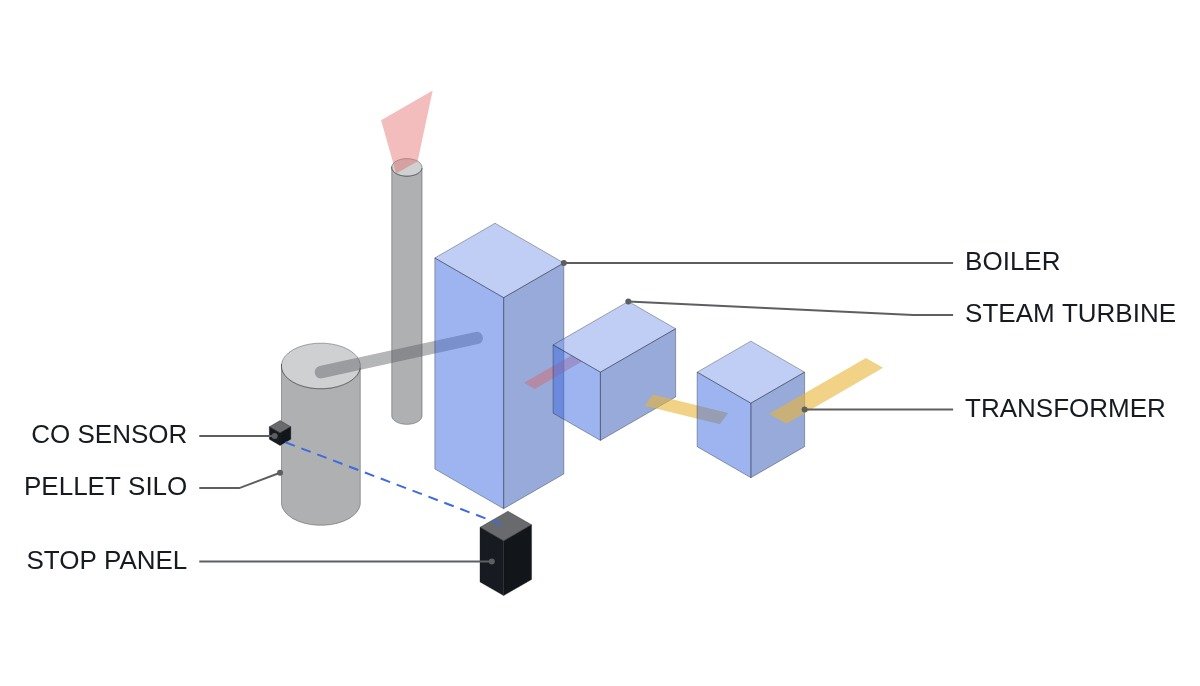
The advantage of stockpiling fuel is inseparable from storage risk. Wood chip piles and pellet silos can self-heat through microbial activity and oxidation, and when conditions line up this leads to spontaneous combustion. In enclosed pellet storage, carbon monoxide can accumulate, so gas checks are needed before personnel enter.
The practical checklist: temperature monitoring inside piles and silos, CO detection and ventilation, explosion-protection conditions on conveying equipment given dust explosion risk, and conveyor stop and isolation on fire detection. That stop-and-isolate path must operate hardwired, independent of controller logic, with the monitoring system handling status supervision. The longer fuel is stored, the higher the self-heating and moisture-uptake risk, so inventory days are set as a balance between supply security and storage safety.
| Item | Biomass | Solar and wind |
|---|---|---|
| Fuel cost | Yes, variable | None |
| Output control | Dispatchable | Weather-dependent |
| Grid inertia | From synchronous generator | Inverter-based, limited |
| Operating staff | Fuel handling and combustion, constant | Mostly remote monitoring |
| Policy sensitivity | Sensitive to fuel eligibility rules | Relatively low |
In this comparison, biomass leads on only two rows, output control and grid inertia; everything else is cost or risk. Biomass value therefore holds only where dispatchability and inertia are paid for on the grid; without that, it becomes a renewable that is worse off by exactly its fuel bill.
Decision Sequence
- List fuel sources by type and convert the volume obtainable over the plant’s life into energy units (GJ).
- Finalize fuel contract terms: unit, moisture ceiling, price adjustment, and supply-interruption clauses.
- Confirm the boiler’s fuel tolerance: moisture, ash, and blending ratio.
- Survey nearby heat demand and choose between power-only and CHP operation.
- Build temperature and gas monitoring, explosion protection, and hardwired stop paths for storage into the design.
- Build scenarios for how revenue changes if policies such as fuel eligibility rules change.
Boundary Conditions
The conditions under which biomass wins are narrow and clear: a stable domestic fuel source within collection radius, year-round heat demand nearby for CHP operation, and a grid that rewards dispatchability. Conversely, if most fuel comes by long-distance import and there is no heat demand so only power is produced, the result is a low-efficiency plant carrying fuel-cost and transport risk.
Policy is also a boundary condition. If the renewable eligibility rules or support levels for the fuel change, revenue changes while the fuel contract stays the same. The mismatch between long-term fuel contracts and short policy cycles is a risk equipment cannot solve, so it has to be handled in the contract terms up front.
The single decision criterion is this: if the fuel needed over the plant’s life can be contracted in energy units, consider biomass; if not, choose a renewable that needs no fuel.