The conclusion first. Whether nuclear cogeneration works is not decided by whether heat can be extracted, but by two variables: the temperature the heat user needs, and the distance from the plant to that user. A light water reactor’s main steam sits around the 280°C range, which suits district heating that uses hot water around 100°C and low-pressure process steam, but not process heat at higher temperatures. And because nuclear plants are sited away from population centers, the longer the heat pipeline, the more heat loss and pipeline capital eat into the gain. If the user is close and consumes large, steady amounts of low-temperature heat, nuclear cogeneration wins. If the temperature is high or the distance long, it is better to send electricity and convert it to heat on site.
Where it wins, where it doesn’t
Start with the current conditions. A light water reactor rejects most of its reactor heat to cooling water in the condenser. For a plant with roughly one-third efficiency, the rejected heat is about twice the energy sent out as electricity. That heat is too low in temperature to be useful, so it goes to the sea or a cooling tower.
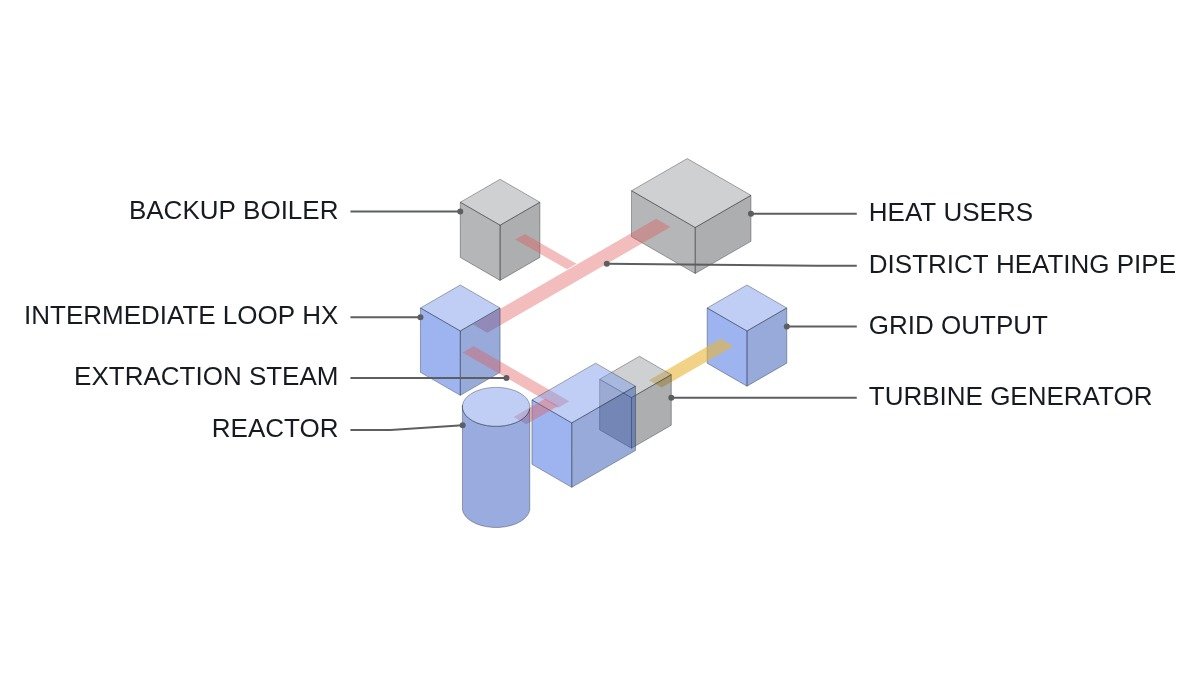
With cogeneration, part of the steam is extracted from an intermediate or low-pressure turbine stage and sent to a heat exchanger, and turbine electrical output drops accordingly. The key is the exchange ratio. The lower the temperature of the extracted steam, the less electricity it could still have made in the turbine, so the electricity lost is small relative to the heat supplied. That is why low-temperature district heating is the best match for nuclear cogeneration.
The connecting logic: the benefit of nuclear cogeneration is not “recycling waste heat” but “an exchange that yields a lot of heat for a small electricity loss.” For that exchange to pay, the demand temperature must be low, the heat must not leak away much on the way to the user, and demand must be steady enough to mesh with the plant’s baseload operation. If any one of the three fails, the exchange-ratio advantage disappears.
Electricity lost versus heat supplied
The calculation structure: let ΔP be the drop in electrical output due to extraction and Q the heat supplied. The exchange ratio is β = ΔP / Q. β gets smaller as the extraction steam pressure and temperature get lower.
Assumptions: a 1,000 MWe class light water reactor, Q = 300 MWth for district heating extracted at a low-pressure stage, β = 0.15 (an illustrative assumption). Then ΔP = 0.15 × 300 = 45 MWe. In other words, 45 MWe of electricity is given up to obtain 300 MWth of heat. Making the same 300 MWth with electric heaters would take 300 MWe; with heat pumps it would still take that heat divided by the coefficient of performance. The real β is set by extraction point, turbine design, and heat-demand temperature, and must be confirmed from the plant’s heat balance diagram.
| Heat demand | Temperature | LWR fit | Key constraint |
|---|---|---|---|
| District heating water | Around 100°C | Good | Pipe distance, seasonal swing |
| Low-pressure process steam | Below main steam | Conditional | Proximity of user |
| Seawater desalination | Low | Good | Site must be coastal |
| High-temperature process heat | Several hundred °C+ | Poor | Main steam temperature limit |
The takeaway: light water reactor cogeneration is limited to “low-temperature, high-volume heat.” High-temperature process heat is not a problem you solve by changing how a light water reactor is operated; it requires a different reactor type altogether.
Radiological isolation and heat supply reliability
The first condition for sending nuclear heat off site is that no radioactive material crosses to the heat user. The usual arrangement places an intermediate loop between turbine extraction steam and the district heating network, with pressures set in steps across each boundary so that any leak flows toward the plant. The intermediate loop carries radiation monitoring, and on an abnormal reading, isolation valves separate that loop.
The second condition is supply reliability. When the plant trips or enters a planned outage, heat supply stops too. Other generators on the grid replace the electricity, but a district heating network needs its own alternative heat source. So the supply reliability of nuclear cogeneration is set not by reactor capacity factor but by backup boiler capacity. If backup equal to the nuclear heat share must be installed separately, that investment belongs in the cogeneration economics.
| Item | Nuclear cogeneration | Transmit power, make heat locally |
|---|---|---|
| Exchange efficiency | High for low-temp heat | Depends on heat pump COP |
| Transport loss | Rises with pipe distance | Transmission loss relatively small |
| Backup needed | Boilers required for plant outages | Grid acts as backup |
| Radiological isolation | Intermediate loop and monitoring | Not applicable |
| Licensing | Plant design change review | Ordinary heat-source permits |
What this table shows is that the cost of nuclear cogeneration sits not inside the plant but outside it, in the pipeline network and backup equipment. Deciding on exchange efficiency alone leaves those two items out and overstates the economics.
Decision sequence
- Confirm the required temperature of the heat demand. If light water reactor main steam cannot supply it, stop the review.
- Confirm pipeline distance and route from plant to user, and estimate transport cost including heat loss and pumping power.
- Look at the seasonal swing in heat demand. If summer demand drops sharply, annual utilization falls and pipeline payback slows.
- Include the capacity and cost of backup equipment that supplies heat during plant outages.
- Estimate the drop in electrical output from extraction and its grid impact on the basis of lost power sales revenue.
Items to verify
- The actual exchange ratio β depends on extraction point, turbine design, and supply temperature and must be derived from the plant’s heat balance diagram. The 0.15 used above is an assumption to show the calculation structure.
- Heat loss and construction cost per unit length of heat pipeline vary widely with pipe size, burial conditions, and insulation, so no figures are given here.
- The licensing scope for adding extraction equipment to a nuclear plant is fixed by regulatory review according to the nature of the design change.
Side effects seen from the power grid
From an electrical engineer’s view there is one more point. When extraction rises in winter with heating demand, the plant’s net output drops by the same amount. Winter is also a period of high electricity demand, so the output given up for heat must be covered by other generators at peak hours. One unit’s reduction looks small, but if several units raise extraction at the same time, it becomes large enough to include in reserve planning.
The other point is transients. If extraction is suddenly cut off by a pipeline incident on the user side or by isolation valve action, that steam returns to the turbine and output jumps momentarily. The power control logic for an extraction cut-off must be defined in advance so the turbine control system can absorb the change, and the actual transient response requires waveform analysis and field measurement on the specific plant.
Boundary conditions
The advantage of nuclear cogeneration flips under three conditions. First, when the user is far enough away that pipeline capital and heat loss exceed the exchange gain. Second, when heat demand swings so much by season that network utilization is low. Third, when heat prices are low relative to electricity prices, so the value of the electricity given up exceeds the value of the heat gained. In those cases the plant should make only electricity, and heat should be made with heat pumps near the user.
Conversely, if the user is near the plant and is an industrial complex or desalination facility consuming large, steady amounts of low-temperature heat year-round, the exchange efficiency of nuclear cogeneration remains a clean gain.
The single selection criterion: nuclear cogeneration wins only when the value of electricity given up by extraction, plus pipeline and backup boiler cost, is smaller than the cost of making the same heat locally from electricity.