Bottom line first. Undergrounding a 345 kV transmission line in a cable tunnel costs about KRW 25.8 billion per kilometer, roughly eight times the KRW 3.22 billion for an overhead line. For an equipment decision, though, that factor of eight is only the starting point. Underground cable brings its own cost items on top of construction: charging-current compensation, longer fault repair times and thermal rating limits. Overhead lines, in turn, bring the time cost of local opposition and permitting delays. The case for undergrounding should be narrowed to “sections where one year of delay costs more than the extra construction cost of that section,” and the default design should be to bury only the contested section, not the whole route.
What was reported
On September 21, Asia Economy covered the investment burden on KEPCO’s transmission and substation network. The 11th Long-term Transmission and Substation Plan commits KRW 72.8 trillion to grid expansion over 2024–2038, 28.8% more than the KRW 56.5 trillion in the 10th plan. The government and KEPCO are due to draw up the 12th plan, which is expected to add grid reinforcement for new demand from AI data centers and semiconductors and for expanding renewables.
The article noted that 15 grid projects (KRW 14.2 trillion in total project cost) were recently exempted from preliminary feasibility studies, and that undergrounding, driven by community acceptance, is a growing cost factor. By KEPCO’s standard construction cost, a 345 kV underground line in a cable tunnel runs about KRW 25.8 billion per km, against KRW 3.22 billion for an overhead line.
Financial figures came with it. KEPCO posted KRW 4.9127 trillion in operating profit for the first half, but its debt rose to KRW 210.7 trillion at end-June, and interest expense alone was KRW 2.1 trillion for the half. Q4 tariffs were frozen, leaving a gap of KRW 2.3 per kWh between the required adjustment rate and the rate actually applied. The article also mentioned discussions on the first government capital injection since 2011 and on roughly KRW 25 trillion in prepaid electricity charges from Samsung Electronics and SK Hynix.
Where it wins, where it doesn’t
Current conditions
Today the bottleneck in building transmission is not technology but permitting and community acceptance. Overhead lines are cheap to build, but when right-of-way negotiations over tower routes drag on, completion slips by years. Meanwhile generators wait in the interconnection queue and large loads wait for supply. The cheapest asset to build is not necessarily the first one to come online.
What changes with undergrounding
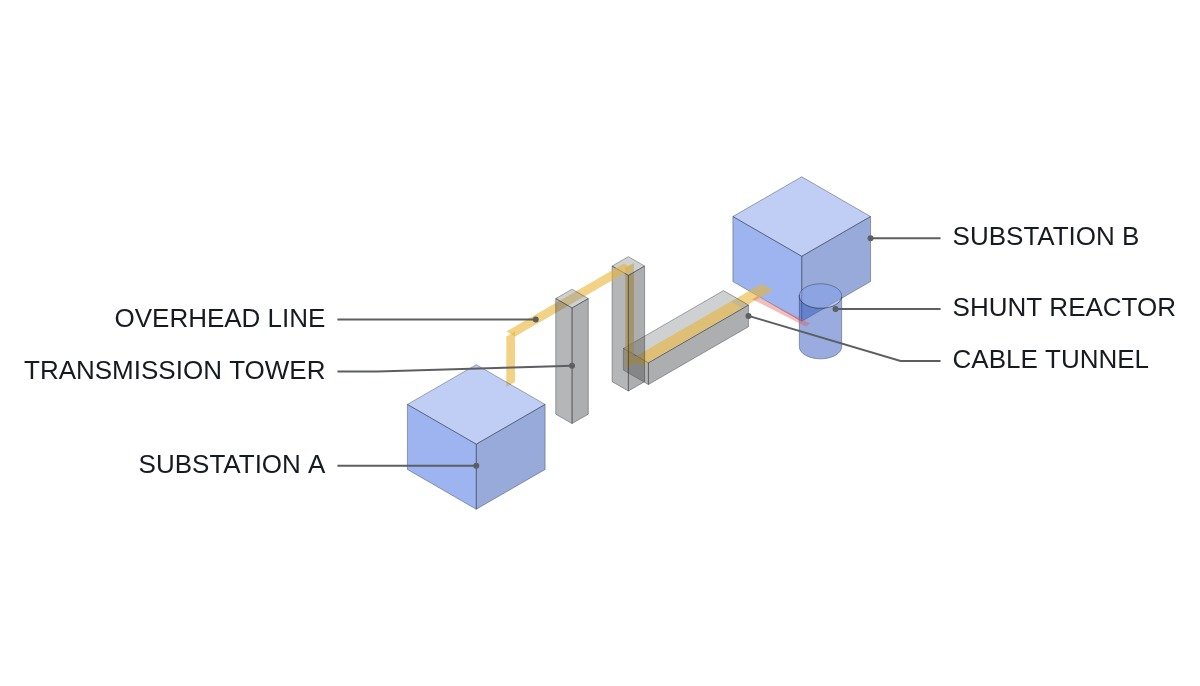
Underground cable reduces route disputes and may pull construction start forward. Transient faults from external causes (lightning, high wind, vegetation contact, icing) also drop structurally. In exchange, tunnel civil works, cable joints and terminations push costs up, and the high capacitance of AC cable creates a new charging-current and reactive-power compensation problem. Locating a fault and re-making joints generally takes longer than on an overhead line.
The connecting logic
The economics of undergrounding therefore reduce to comparing “the construction cost difference” with “the value of avoided delay.” If the contested section is short and it is holding up the whole line, undergrounding is effectively the price of securing the schedule. Burying sections with no route dispute means paying eight times the construction cost with no schedule gain. The unit of decision is the section, not the line.
Overhead versus underground, from the equipment side
| Item | Overhead | Underground (tunnel) |
|---|---|---|
| 345 kV cost (reported) | KRW 3.22 bn/km | approx. KRW 25.8 bn/km |
| Community acceptance | Tower/route disputes | Relatively favorable |
| External-cause faults | Exposed to lightning, wind, icing | Structurally fewer |
| Fault repair | Visual check, fast replacement | Locating and re-jointing take longer |
| Reactive power | Charging current relatively small | Large charging current, compensation needed |
| Ampacity driver | Wind, ambient temp, solar | Soil thermal resistivity, tunnel ventilation |
The rows to read are not the first but the fourth and fifth. The standard cost of KRW 25.8 billion per km does not include reactive compensation equipment or supply lost during the repair period. The longer the underground section, the more likely compensation such as shunt reactors will follow, so the comparison has to be made on total cost including the terminal substations, not on the per-km line rate.
Extra cost by section length
Using only the reported unit costs, the difference by section length is as follows. The formula is “underground rate × length − overhead rate × length”; reactive compensation, land and compensation payments are excluded.
| Buried section | Overhead | Underground | Difference |
|---|---|---|---|
| 1 km | KRW 3.22 bn | KRW 25.8 bn | KRW 22.58 bn |
| 5 km | KRW 16.1 bn | KRW 129 bn | KRW 112.9 bn |
| 10 km | KRW 32.2 bn | KRW 258 bn | KRW 225.8 bn |
The difference scales linearly with length, but the value of avoided delay does not. Whether the contested section blocking the whole line is 1 km or 10 km, the schedule gain from clearing it is the same. So the undergrounding decision should be recast as a minimum-section problem: “how many kilometers must be buried to unblock the whole line?” Any undergrounding beyond that minimum should be classified not as a schedule cost but as a community-relations cost. Only with that classification can the growing undergrounding volume in the 12th plan be explained separately from the tariff and capital-injection debate.
Items for equipment engineers to check
- Identify the contested section: first fix which sections are actually blocked in permitting or route negotiation, and their length. The undergrounding scope starts there.
- Reactive power study: confirm through grid studies the receiving-end voltage rise caused by charging current in the underground section and whether compensation is needed. Light-load hours are the reference case.
- Protection coordination: mixed overhead/underground lines have different impedance by section, so distance relay settings and the use of auto-reclosing must be reviewed. Whether to apply reclosing to cable-section faults follows the utility’s operating rules.
- Ampacity: check that the ampacity calculated for tunnel ventilation and soil thermal resistivity matches the overhead sections. The bottleneck sometimes moves to the underground part.
- Restoration plan: secure spare cable and joint materials, and define the alternative power-flow path during repair, in advance.
- Items to verify: the article does not say whether the KRW 25.8 billion rate includes terminations or compensation equipment. This needs checking against project cost breakdowns.
Boundary conditions
The case for undergrounding reverses under three conditions. First, when non-contested sections are buried wholesale: only the eightfold construction cost remains, with no schedule gain. Second, when an AC underground section grows long enough that reactive compensation becomes large; the substation-side equipment then outweighs the line rate, and in some cases the study has to move to DC transmission. Third, when KEPCO’s funding is constrained and construction itself slips. With KRW 210.7 trillion in debt and frozen tariffs, choosing the more expensive asset can push a project down the construction queue, wiping out the schedule gain undergrounding was meant to buy.
Charging current and voltage rise in underground cable vary with site conditions, so each section requires grid studies and field measurement. The single decision rule is this: choose undergrounding only when one year of delay to the whole line caused by that section costs more than the roughly KRW 22.58 billion of extra construction per buried kilometer.
References
- Asia Economy (아시아경제), “송전망 73조도 빠듯한데 지중화까지…커지는 한전 부채 부담” (Undergrounding on top of a tight KRW 73 trillion grid plan: KEPCO’s growing debt burden), 2026-09-21, https://view.asiae.co.kr/article/2026092110130275932