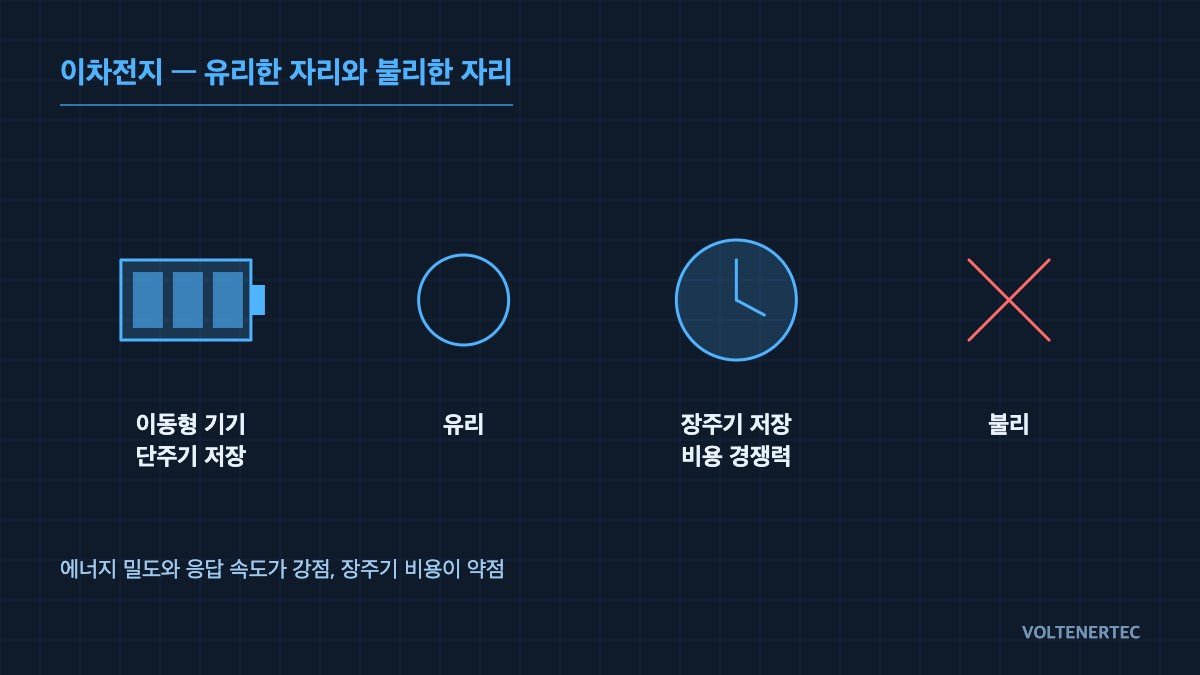
Secondary batteries may seem suited to everything, but where they truly excel is well defined. The key lies in the combination of energy density and response speed.
Where It Wins
| Use Case | Reason |
|---|---|
| EVs & mobile devices | High energy density per weight favors mobile applications |
| Short-duration ESS (a few hours or less) | Fast charge/discharge response handles instantaneous load swings well |
| Residential solar-linked storage | Easy to install and maintain at small-to-medium capacity |
Takeaway: what these three use cases share is that required power and response speed, rather than the amount of energy, drive the design. The more power is the main requirement, the stronger the case for secondary batteries.
Where It Struggles
It is unfavorable for long-duration storage (days to seasonal). The longer energy must be stored, the more the per-cell cost accumulates directly, so for large-capacity, long-duration storage, other energy sources (pumped hydro, hydrogen, etc.) take the cost advantage.
Summary
Secondary batteries are strongest in applications that are “fast, mobile, and short-duration.” Their competitiveness declines as the required storage duration grows longer.
Where It Wins, Where It Struggles: Reading the Conditions
- Wins — short-cycle load response — Current condition: instantaneous load swings and peaks are carried by generators or the grid supply alone. → After applying: the PCS reverses charge/discharge direction quickly and absorbs the swings. → Link: what is needed is response speed rather than stored energy, so the weakness of cell cost scaling with storage time never shows.
- Wins — mobile equipment — Current condition: weight and volume directly limit operating performance. → After applying: high energy density per weight gives longer run time at the same weight. → Link: operation needs only charging, with no fuel supply system, so the system stays simple.
- Struggles — long-duration, large-capacity storage — Current condition: energy must be shifted over days or seasons. → After applying: longer storage means stacking more cells, and BMS, cooling and fire-protection equipment grow with cell count. → Link: the longer the storage, the less often it is used, while investment still grows cell by cell, so payback worsens.
The Structure of a Battery ESS from the Equipment Side
A battery ESS sizes the PCS, which handles power, separately from the battery racks, which hold energy. The ratio of battery capacity (kWh) to PCS rating (kW) is the time the system can discharge at rated power. This is why the cost of extending storage time lands almost entirely on the cells. Conversely, in applications that need high power but short storage time, the cell cost burden is small and only the response-speed advantage remains.
As the system grows, the equipment around the cells grows with it: the BMS that monitors cell voltage and temperature, rack cooling, and fire-propagation protection. Safety requirements and thermal-runaway propagation testing are checked against the IEC and UL families of ESS safety standards.
The same structure shows up in operation. In short-cycle duty the system charges and discharges several times a day, so aging advances with accumulated cycles; in long-duration duty it spends most of its time waiting at a high state of charge, so calendar aging and standby consumption become the issue. Either way, aging behavior depends on cell chemistry and operating temperature and must be confirmed from manufacturer data and measurement.
Character Comparison with Alternative Storage
| Item | Secondary battery | Pumped hydro | Hydrogen |
|---|---|---|---|
| Response speed | Very fast | Fairly fast | Depends on conversion equipment |
| Where extra storage time costs | All cells | Upper reservoir volume | Storage tanks and equipment |
| Siting constraints | Small | Large (terrain needed) | Moderate (safety distance, storage) |
| Mobile use | Suitable | Not possible | Possible (fuel cell vehicles) |
| Scale flexibility | From small scale | Mostly large scale | Mostly medium to large |
Takeaway: the battery’s strengths come from small scale and fast response, and its weakness from the cost of extending storage time. The moment storage time grows, the comparison shifts to other storage methods.
Checklist Before Adoption
- Has the core requirement been classified as power (kW) or energy (kWh)?
- Has the required discharge duration been confirmed from measured load profiles? (item to verify)
- Are the PCS and battery racks sized separately, leaving room to expand each?
- Are BMS alarm and trip signals tied to PCS shutdown through a hardware interlock?
- Do ventilation, cooling and fire-protection conditions at the site meet the applicable standards?
- Does the operating plan account for capacity loss from cell aging over the service life?
Boundary Conditions
The battery’s advantage holds when the required storage time is short and power response matters. The judgment flips under three conditions: when storage time grows until cell cost dominates the investment, when large-scale storage is needed and terrain suited to pumped hydro is available, and when strict fire-protection conditions at the site make the auxiliary burden of mass cell installation heavy. Under these conditions, falling cell prices do not easily change the verdict.
Single selection criterion: if a short discharge duration and response speed dominate the design, choose secondary batteries; if storage time dominates, look at other storage methods first.
Related reading (Korean) — EV Battery Chemistry Comparison — NCM vs. LFP, What’s the Difference?