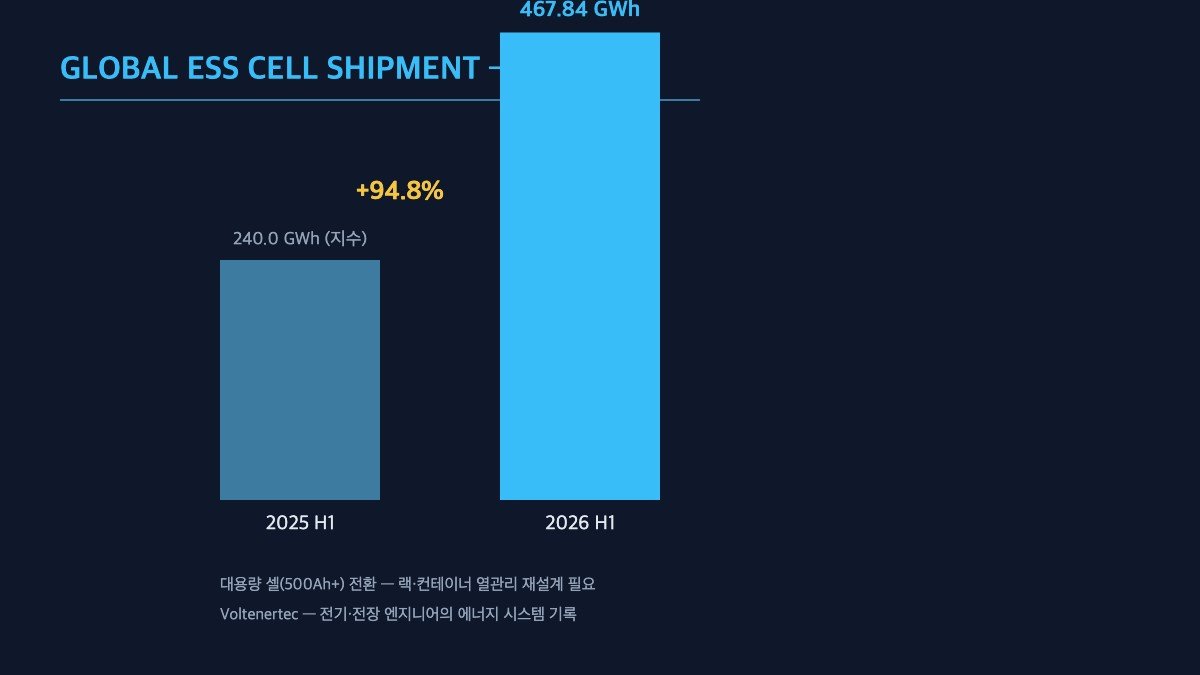
Global ESS cell shipments in the first half reached 467.84 GWh, up 94.8% year on year. Three structural shifts were confirmed along with it, including the move to large-format cells. The key question behind these figures is under what conditions large-format cells become advantageous, and under what conditions the thermal management burden tips the balance the other way.
Adoption of large-format cells (500 Ah and above) is rising because they reduce the number of parts, wiring runs, and weld points per rack, lowering both assembly cost and contact-resistance risk. Samsung SDI’s move to take over sole operation of its US joint-venture plant with GM (annual capacity 27 GWh) to meet ESS demand from AI data centers and power grids is part of the same trend. In Korea, the Korea Power Exchange has announced the third round of bidding for its ESS central contract market.
| Item | Figure |
|---|---|
| H1 ESS cell shipments | 467.84 GWh |
| Year on year | +94.8% |
| Samsung SDI GM plant capacity | 27 GWh/yr (converted to sole operation) |
What this table says — if shipment growth outpaces the update cycle of rack and container designs, there may be a window in which thermal management and fire safety (thermal runaway suppression) designs based on large-format cells fail to keep up. There is, however, a boundary condition that reverses this judgment: some cases have been reported in which larger cells actually simplify the thermal runaway propagation path and make suppression design easier, so reading large-format adoption purely as a risk signal is premature.
From an electrical and control engineer’s standpoint, there is one checkpoint to apply immediately — when reviewing a new ESS container specification, explicitly require the supplier to state the allowable maximum temperature difference (ΔT) within the pack for each cell Ah rating. With large-format adoption now the central topic, having this figure in hand lets you decide quickly whether a rack redesign is needed down the line.
What fewer parts per rack changes at the equipment level
The reduction in parts, wiring, and weld points is a real gain, but it moves the design problem rather than removing it. Fewer cells per rack means fewer series and parallel joints, fewer busbar connections, and fewer places where a loose or degraded joint can build contact resistance and local heating. That is the part of the argument that favors large-format cells, and it is a maintenance argument as much as a cost argument.
The other side follows from the same geometry. A larger cell stores more energy per unit, so a single cell failure involves more energy than it would in a rack of smaller cells. Heat generated inside a larger cell also has a longer path to the cooled surface, which is exactly why the in-pack temperature difference becomes the figure to watch. A rack that was thermally designed around smaller cells does not automatically carry over when larger cells are dropped into it.
For the battery management system, the change shows up in sensing. With fewer, larger cells, each temperature and voltage point represents more stored energy. Whether the existing sensing layout still resolves a developing hot spot in time is a question for the supplier’s test data, not something to assume from the previous generation.
Character comparison: conventional vs large-format cells
| Aspect | Conventional cells | Large-format cells |
|---|---|---|
| Parts and welds per rack | More | Fewer |
| Contact-resistance points | More | Fewer |
| Energy per single cell | Smaller | Larger |
| In-pack temperature spread | Better characterized | Needs supplier data |
| Propagation path | More cell boundaries | Can be simpler |
What this table shows is that large-format cells trade connection-related risk for concentration-related risk. Whether the trade is favorable depends on whether the rack and container thermal design was updated for the new cell size, not on the cell size itself.
Items to verify when reviewing a container specification
- Allowable in-pack ΔT stated per cell Ah rating, as a documented value from the supplier.
- Whether the rack and cooling design was revised for the large-format cell, or whether only the cells were changed in an existing rack.
- Propagation test evidence performed at the actual cell rating being offered, not at a smaller predecessor.
- Temperature and voltage sensing layout per cell, and how a local hot spot is detected.
- Fire safety design basis for the container, and whether it references the large-format configuration.
- Delivery timing relative to the design update cycle, since the risk window described above sits exactly there.
What to revisit in protection and metering design
Larger cells change the parallel string arrangement for the same rack capacity, and increase the energy a single cell can release into a short-circuit fault. The interrupting capacity of rack-level DC breakers and fuses, and the selective coordination between upstream and downstream devices, should be re-reviewed for the new configuration rather than carried over from values checked for the previous cell arrangement. Fault current contribution and interruption behavior should be confirmed with supplier data, and anything that depends on field measurement requires waveform analysis and on-site measurement.
When a cell change is handled as “only a cell change”, the protection review is easily skipped. Adding the protection coordination study to the list of documents to be revised at the specification review stage is the cheapest practical safeguard.
Boundary conditions
The case for large-format cells holds when the supplier can document both the in-pack temperature difference for the offered Ah rating and the propagation behavior of the complete rack; in that situation, fewer parts and fewer contact-resistance points are a net gain. The case reverses when large-format cells are fitted into rack and container designs that were thermally sized for smaller cells, because the reduced part count does not compensate for heat and energy concentrated in each cell.
The single selection criterion is this: has the supplier stated, in writing, the allowable in-pack ΔT for the specific cell Ah rating being offered?
Sources: pv-magazine.com (2026-08-17), Digital Daily (2026-08-16)