For Korean cell makers that already have production bases in Europe, now is the right time to expand; for companies considering a new entry, it pays to wait until the European cost structure for power and labour normalises. With Germany’s Varta following Northvolt into insolvency proceedings, the European battery industry is showing signs of a chain collapse, but this signal works in opposite directions for companies already running plants in Poland and Hungary and for those considering a new entry.
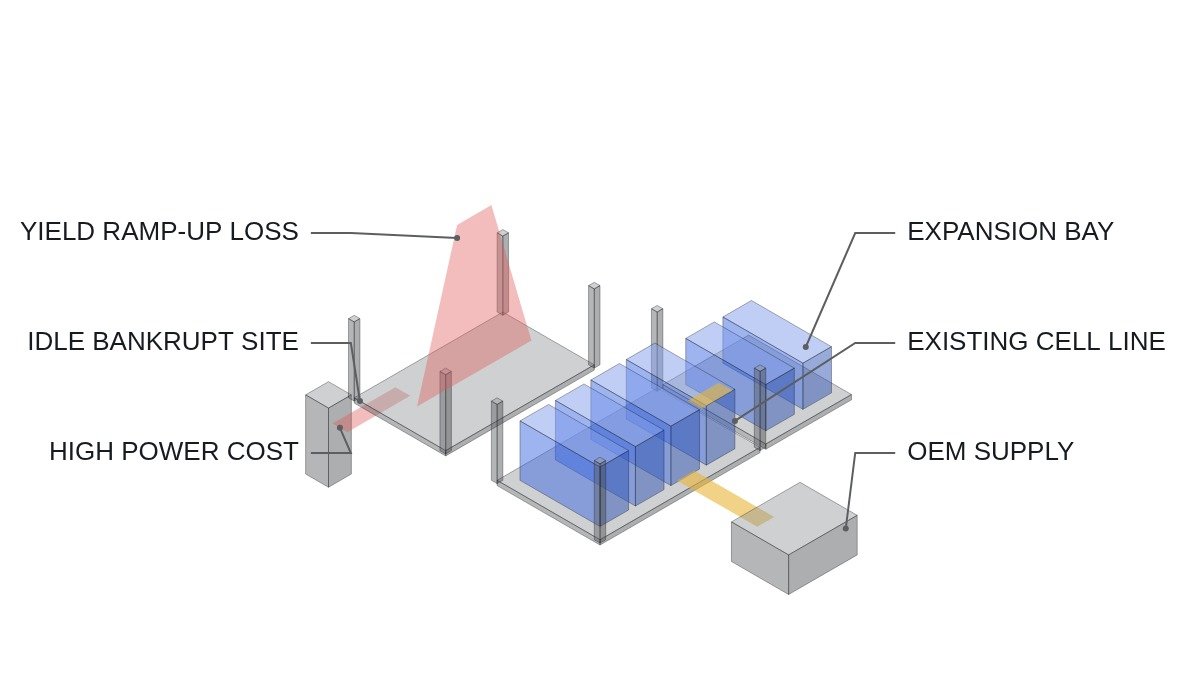
Where it wins: companies already present (LG Energy Solution, Samsung SDI, SK On)
Current condition: LG Energy Solution in Poland, and Samsung SDI and SK On in Hungary, have already built production lines and secured local workforces and supply chains.
What changes: As competitors such as Northvolt and Varta drop out, there is room to absorb sites, skilled workers and component supply chains, which had been fiercely contested, at relatively lower cost. Automotive OEMs also gain a stronger incentive to shift volume to established companies with a proven supply record.
Connecting logic: Expanding a line that is already running involves shorter permitting and yield ramp-up periods than a new greenfield project, so spill-over demand turns into actual revenue faster.
Where it doesn’t: companies considering a new entry
Current condition: The power and labour cost structure, higher than the European average, remains unchanged, and the causes of the Northvolt and Varta insolvencies come down to failure to secure yield and failure to secure financing.
What changes: Even if a new entrant acquires idle equipment or sites from bankrupt companies cheaply, it still has to carry the full learning curve of bringing cell production yield onto a normal track. The risk of sustained losses during the low initial yield period is greater than for established companies.
Connecting logic: In the current phase, an unproven new entry makes careful wait-and-see the rational choice.
| Item | Already present | Considering new entry |
|---|---|---|
| Site and workforce cost | Falling as competitors exit | Falling equally, but no experience using them |
| Yield risk | Data accumulated from existing lines | Learning curve must be climbed again |
| OEM trust | Proven by supply record | New qualification needed |
| Policy incentives (European Battery Alliance) | Also apply to expanding existing lines | Can also apply to new entry |
| Rational timing | Now (right time to expand) | After yield and power cost structure normalise |
Where the table splits is ultimately whether a company has already proven yield data. LG Energy Solution’s push to strengthen patent management, expanding its patent holdings to about 86,000 (as of October 2024), can also be read as a move to lock in domestic production technology as a defensive asset.
Reading the bankruptcies from the production floor
From the equipment side, the word that matters most in this story is yield. A cell line is a long chain of process equipment, and a new line does not produce saleable cells on day one. Every process step has to be tuned, every inspection criterion has to be validated against real defects, and the control parameters that keep the line stable have to be learned from the line’s own data. That data does not transfer with the building.
This is why buying a bankrupt competitor’s site is not the same as buying its capability. The equipment may be installed, the utilities may be connected, and the permits may exist, but the operating knowledge that turns that equipment into consistent output left with the people and the data. An established company expanding next to its existing line brings that knowledge with it. A new entrant, even in a ready-made building, starts the ramp from the beginning.
Power cost belongs in the same picture. Cell production is an energy-intensive process, and during the low-yield period a plant consumes power to make cells that are later scrapped. The higher the power cost, the more expensive each month of ramp-up becomes. That is how the power cost structure and the yield learning curve combine against a new entrant at the same time.
What each entry route actually brings
The comparison can be broadened by looking at the three realistic routes into European production by character rather than by numbers.
| Route | What it brings | What it still lacks |
|---|---|---|
| Expanding an existing line | Yield data, workforce, OEM record | Little; mainly capital and time to install |
| Acquiring a bankrupt plant | Site, building, possibly permits | Yield know-how, OEM qualification |
| New greenfield plant | A layout designed for its own process | Permits, workforce, yield data, OEM record |
The table shows that acquisition sits between the other two routes but does not remove the hardest item. It can shorten the physical build, but the yield learning curve and OEM qualification stay with the buyer. That is why acquisition becomes attractive only when policy support targets exactly the part it shortens, the permitting and build time.
Order of judgement for an expansion decision
- Check whether the company already runs a line in Europe. This is the first branch; everything else follows from it.
- Check whether yield data can transfer. Expansion near an existing line with the same process carries data over; a different process or format may not.
- Check the power cost exposure during ramp-up. Estimate how long the low-yield period will run and what the site’s power cost does to it.
- Check OEM commitment. Spill-over demand from exited competitors becomes revenue only when an OEM actually moves volume.
- Check where policy incentives are pointed. Whether support favours expansion of existing lines or acquisition-type entry decides whether the second route becomes viable.
Boundary conditions: when this conclusion flips
However, if the EU puts strong policy support behind its target for regional battery self-sufficiency and concentrates subsidies and tax benefits on acquiring bankrupt companies’ production lines and permits wholesale, the story changes. In that case even a new entry can cut permitting time sharply compared with greenfield, making it conditionally favourable. In the end, the final criterion narrows to one: how far European policy incentives lean toward acquisition-type new entry. Until that variable is confirmed, it is safer to use proximity to an existing production base as the single selection criterion.
References
- The Guru, Signs of collapse in the European battery industry: Varta may follow Northvolt into bankruptcy (Korean)
- Bridge Economy, European battery bankruptcies: opportunity and test for K-batteries (Korean)
- The Korea Herald, LG Energy Solution turns to patent power in battery slowdown