Conclusion. On September 2, Doosan Fuel Cell signed a KRW 501.4 billion phosphoric acid fuel cell (PAFC) supply contract with its affiliate Hyaxiom, entering the US AI data center on-site power market for the first time. The products will be delivered in sequence from the second half of 2026 through the first half of 2028. From an electrical engineer’s standpoint, the conclusion is this: the success of this contract depends not on electrical efficiency but on the design of the coolant-system interlocks. In on-site power that must run continuously 24 hours a day, rising coolant conductivity is a leading signal of stack contamination. Tie it to an immediate shutdown trip and the non-stop availability the data center requires cannot be met; ignore it and filter and stack life are shortened. Separating shutdown interlocks and maintenance interlocks into distinct grades is the practical technical condition of this on-site power business.
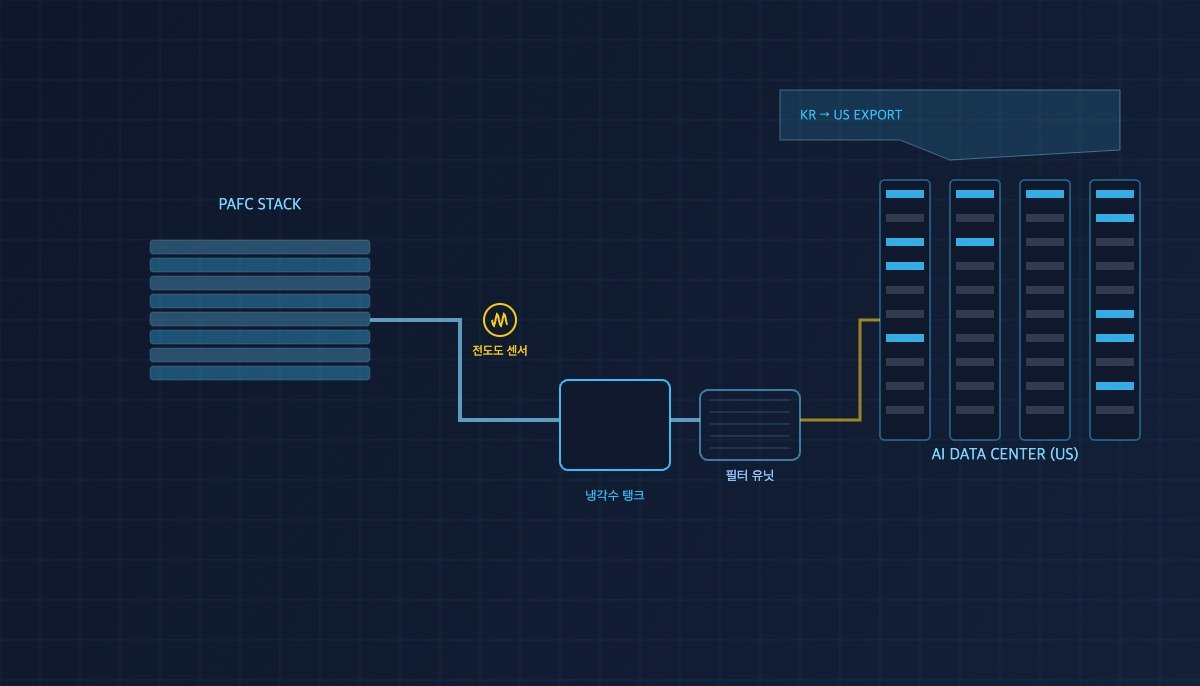
Rising coolant conductivity is not a failure but a warning. Treat that warning as a shutdown grade and you lose availability; ignore it and you lose stack life.
Some background. According to Electric Power Journal (Jeongi Sinmun), Doosan Fuel Cell disclosed a KRW 501.4 billion PAFC supply contract with its US subsidiary Hyaxiom on September 2. Behind it is the grid bottleneck in the United States. As growth in AI data center power demand outpaces the construction of power plants and transmission and distribution networks, global big tech companies are expanding on-site power to bridge the time gap: grid expansion takes years, while a data center is typically built in around 18 months. Doosan Fuel Cell has more than 800MW of installed references and about 275MW of annual production capacity at its Iksan plant, and says that high electrical efficiency and 24-hour continuous operation match data centers’ requirements for power reliability.
Preconditions (based on the operating time chart). The facts confirmed in this disclosure are the contract size (KRW 501.4 billion), the delivery period (second half of 2026 to first half of 2028), the supplying entity (Hyaxiom) and the production base (Iksan plant). The exact coolant conductivity trip threshold at individual sites, whether maintenance alarms and shutdown trips are separated by grade, and the availability figure (SLA) required by the data center side are not included in the disclosure. The interlock sequence and I/O map below are conceptual examples that translate general control principles for phosphoric acid fuel cell cooling systems into an electrical control configuration.
Safety interlock check sequence (highest priority)
- Confirm the hardwired emergency stop (EMO) first — the stack emergency stop signal operates through hardwiring regardless of communication or upper-level controller status, and any configuration that bypasses it in software is excluded.
- Confirm grid-interconnection protective relay status — before starting the stack, confirm that the transfer conditions for parallel and islanded operation with the data center’s own switchgear are normal.
- Confirm coolant tank low-level status — a coolant shortage is a deficiency condition that must be handled before conductivity is even measured.
- Split coolant conductivity into two threshold stages — build a maintenance alarm grade (warning, schedule filter replacement) and a shutdown trip grade (stack protection, immediate stop) as separate signals rather than tying them to a single threshold (specific values require confirmation of manufacturer specifications).
- Run the filter cleaning cycle independently of the shutdown trip — tie the filter cleaning cycle to the maintenance-grade alarm, but keep the stack shutdown trip path live at all times, including during cleaning.
PAFC cooling-system interlock I/O map (example)
| Signal | I/O address | Type | Operating condition |
|---|---|---|---|
| Emergency stop (EMO) | DI_EMO_TRIP | Digital In (hardwired) | Cuts off the stack immediately regardless of upper controller status |
| Grid-interconnection status | DI_GRID_INTERCONNECT_OK | Digital In | TRUE when parallel/islanded transfer conditions are normal |
| Coolant tank level | DI_COOLANT_TANK_LEVEL_LOW | Digital In | Start inhibited on low level; top-priority deficiency condition |
| Coolant conductivity | AI_COOLANT_CONDUCTIVITY_US_CM | Analog In | µS/cm; maintenance and shutdown thresholds split into two stages (values to be confirmed) |
| Filter cleaning request | DO_FILTER_CLEAN_CYCLE_ENABLE | Digital Out | ON when conductivity exceeds the maintenance grade; separate path from the shutdown trip |
| Stack shutdown trip | DO_STACK_TRIP | Digital Out | ON only on EMO or conductivity above the shutdown grade |
| Stack run status | DI_STACK_RUN | Digital In | TRUE during normal generation; passed to the PMS in real time |
The implication of this I/O map fits in one line. Only by branching DO_FILTER_CLEAN_CYCLE_ENABLE and DO_STACK_TRIP from the same conductivity signal at different thresholds can the two conflicting requirements — the non-stop availability the data center demands and protection of the stack — be met at the same time.
PLC logic snippet (IEC 61131-3 Structured Text pseudocode)
(* PAFC coolant conductivity two-stage interlock - conceptual example, unrelated to actual manufacturer specifications *)
(* Note: specific thresholds not found in the disclosure are not included *)

VAR
    DI_EMO_TRIP : BOOL;                        (* emergency stop, hardwired *)
    DI_GRID_INTERCONNECT_OK : BOOL;            (* grid-interconnection transfer normal *)
    DI_COOLANT_TANK_LEVEL_LOW : BOOL;          (* coolant low level *)
    AI_COOLANT_CONDUCTIVITY_US_CM : REAL;      (* coolant conductivity, uS/cm *)
    MAINT_THRESHOLD_US_CM : REAL := 5.0;       (* maintenance-grade threshold, value to be confirmed *)
    TRIP_THRESHOLD_US_CM : REAL := 15.0;       (* shutdown-grade threshold, value to be confirmed *)
    DO_FILTER_CLEAN_CYCLE_ENABLE : BOOL;
    DO_STACK_TRIP : BOOL;
END_VAR

(* Maintenance grade: request filter cleaning only, generation continues *)
DO_FILTER_CLEAN_CYCLE_ENABLE := (AI_COOLANT_CONDUCTIVITY_US_CM >= MAINT_THRESHOLD_US_CM)
    AND (AI_COOLANT_CONDUCTIVITY_US_CM < TRIP_THRESHOLD_US_CM);

(* Shutdown grade: cut off immediately on any of EMO, low level, or conductivity upper limit *)
DO_STACK_TRIP := DI_EMO_TRIP
    OR DI_COOLANT_TANK_LEVEL_LOW
    OR (AI_COOLANT_CONDUCTIVITY_US_CM >= TRIP_THRESHOLD_US_CM)
    OR (NOT DI_GRID_INTERCONNECT_OK);
Boundary conditions — handling field variables
There are points where the advantage of this design principle flips. The disclosure only made public the contract amount and delivery schedule; it did not reveal the coolant conductivity thresholds at individual data center sites or the actual ranges of the maintenance and shutdown grades. The threshold examples in this article (5.0 and 15.0 µS/cm) are conceptual values drawn from general water-treatment management practice and are not Doosan Fuel Cell’s actual control specifications — they require confirmation.
Also, the cited patent (CN110140249B) is a general fuel cell coolant sensing and filtering technology in the name of Doosan Corp, and public information does not confirm whether the same logic is applied in the actual PAFC products under this supply contract. The effect of communication delay or noise on conductivity sensor readings requires waveform analysis and field measurement. There is one single selection criterion — whether the coolant conductivity signal has been split into maintenance and shutdown grades with separate thresholds. Until that separation is confirmed, non-stop operation matched to the data center SLA should not be assumed.
References
Electric Power Journal (Jeongi Sinmun), “Doosan Fuel Cell hits KRW 500 billion jackpot… breaks into US AI data centers” (posted 2026-09-02 13:09, reporter Jeong Se-young, citing Doosan Fuel Cell’s disclosure)
Patent CN110140249B, Doosan Corp, “Fuel cell device and control method thereof” — filed 2017-12-28, granted 2022-07-22, legal status per Google Patents: Expired (Fee Related), anticipated expiration 2037-12-28. It claims a fuel cell stack, a humidification unit, a coolant storage tank, and a filter unit that filters coolant after its conductivity is sensed, and is cited here as background technology for the coolant conductivity interlock. Whether the same technology is applied in Doosan Fuel Cell’s current PAFC product line has not been confirmed.