Conclusion. E2Z (Etwoz), an integrated energy solutions company, is taking part as an EPC partner in the Jeju VPP demonstration project with TEMPACT, a high-safety, high-intelligence ESS that brings precision common-mode voltage (CMV) measurement into safety diagnostics. The product’s core technology, Thermashield, circulates coolant through cooling plates in normal operation and, when an abnormal signal such as off-gas occurs, supplies coolant directly into the module through the same piping to stop heat from spreading.
From an electrical engineer’s point of view, the conclusion is this. Sharing one piping system for cooling and fire suppression reduces the reliability loss that comes with dual piping, but it also means that a malfunction of a single changeover valve can disable both cooling and suppression at once. If the three signals — CMV, off-gas and arc — are grouped at the same level to switch the valve, the risk of unnecessary extinguishing agent release due to false detection increases. An interlock design that separates these three into a diagnostic class and a protection class is therefore the real safety condition of this product.
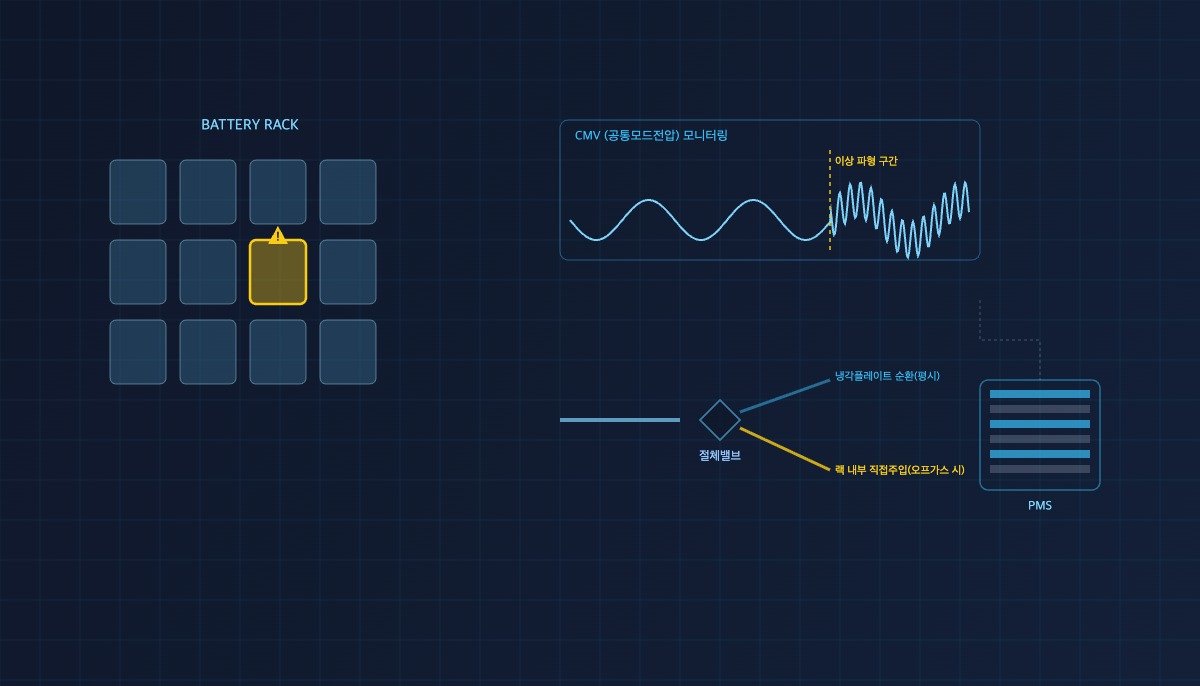
The moment diagnostic signals and protection signals are tied to the same threshold, the advantage of early diagnosis turns into a risk of malfunction from false detection.
Some background. According to an Electric Times report, E2Z is an integrated energy solutions company linking solar power systems, building-integrated photovoltaics, ESS and AI monitoring technology, and has accumulated 45 registered patents since its designation as an Excellent Procurement Product in the ESS field in 2020. Its flagship product TEMPACT adds precision common-mode voltage (CMV) measurement to safety diagnostics on top of temperature, gas, arc and insulation resistance, and all measured values are sent in real time over the communication network to the power management system (PMS), so abnormal signs can be confirmed and cut off immediately.
Building on its field experience in constructing in Jeju Korea’s first stand-alone ESS connected directly to the distribution grid, the company is participating as an EPC partner in the “ESS demonstration project for the Jeju VPP” led by KEPCO, and plans to apply LFP batteries, which offer good thermal stability, at Hallym Aerospace High School.
Preconditions (based on the operating time chart). The facts confirmed in this report are the composition of TEMPACT’s detection indicators (temperature, gas, arc, insulation resistance, CMV) and the concept of Thermashield (cooling plate circulation in normal operation, direct injection into the module on abnormality). The specific CMV trip threshold (mV), the changeover valve response time (ms), and how long-term corrosion and contamination of the shared cooling/suppression piping are managed are not included in the published material. The interlock order and I/O map below are concept examples that translate this structure into an electrical configuration.
Safety interlock check order (top priority)
- Confirm the hardwired emergency stop (EMO) first — the rack emergency stop signal cuts off the PCS through hardwiring regardless of PMS or AI monitoring status; configurations that bypass it in software are excluded.
- Assign off-gas and arc detection to the protection class first — an off-gas or arc detection signal is the top-priority protection condition that immediately switches the changeover valve to suppression mode.
- Separate CMV into the diagnostic class — a common-mode voltage abnormality is an early sign of insulation deterioration, but on its own it does not switch the valve to suppression mode; it only sends a maintenance alarm to the PMS (it is reflected in protective action only in an AND condition with off-gas or arc).
- Confirm changeover valve position feedback — judge suppression as complete only after a position sensor confirms that the valve has actually reached the suppression-mode position.
- Keep insulation resistance drop as a separate trip — insulation resistance drop may share physical causes with CMV, but from an electric shock protection standpoint it keeps an independent trip path.
TEMPACT cooling/suppression interlock I/O map (example)
| Signal | I/O address | Type | Operating condition |
|---|---|---|---|
| Emergency stop (EMO) | DI_EMO_TRIP | Digital In (hardwired) | Cuts off PCS immediately regardless of PMS/AI status |
| Off-gas detection | DI_OFFGAS_DETECT | Digital In | Protection class; top-priority input for switching valve to suppression mode |
| Arc detection | DI_ARC_DETECT | Digital In | Protection class; switches valve in OR condition with off-gas |
| Common-mode voltage | AI_CMV_MV | Analog In | mV, diagnostic class (cannot switch valve on its own; threshold to be verified) |
| Insulation resistance | AI_INSULATION_RESISTANCE_KOHM | Analog In | kΩ; separate trip path kept on drop |
| Changeover valve position | DI_COOLANT_VALVE_POS_EXT | Digital In | Completion judged after suppression-mode position is confirmed |
| Cooling/suppression changeover valve drive | DO_COOLANT_EXTINGUISH_ENABLE | Digital Out | ON only on off-gas OR arc detection |
| PCS stop trip | DO_PCS_TRIP | Digital Out | ON on EMO or insulation resistance drop trip |
The implication of this I/O map fits in one line. DO_COOLANT_EXTINGUISH_ENABLE is driven only by the OR of DI_OFFGAS_DETECT and DI_ARC_DETECT, and AI_CMV_MV is excluded from that path. However sensitively CMV picks up an abnormality, no extinguishing agent is released without the physical confirmation of off-gas or arc — and that configuration is the minimum condition for lowering the false-detection risk of this shared-valve structure.
PLC logic snippet (IEC 61131-3 Structured Text pseudocode)
(* TEMPACT cooling/suppression changeover valve interlock - concept example, unrelated to actual manufacturer specification *)
(* Note: specific thresholds and response times not found in published material are not included *)

VAR
    DI_EMO_TRIP : BOOL;                          (* emergency stop, hardwired *)
    DI_OFFGAS_DETECT : BOOL;                     (* off-gas detection, protection class *)
    DI_ARC_DETECT : BOOL;                        (* arc detection, protection class *)
    AI_CMV_MV : REAL;                            (* common-mode voltage, mV, diagnostic class *)
    CMV_DIAG_THRESHOLD_MV : REAL := 300.0;       (* diagnostic alarm threshold, value to be verified *)
    AI_INSULATION_RESISTANCE_KOHM : REAL;        (* insulation resistance, kOhm *)
    INSULATION_TRIP_KOHM : REAL := 100.0;        (* insulation trip threshold, value to be verified *)
    DO_COOLANT_EXTINGUISH_ENABLE : BOOL;
    DO_PCS_TRIP : BOOL;
    DO_CMV_MAINT_ALARM : BOOL;
END_VAR

(* Protection class: drive changeover valve only on off-gas or arc detection; CMV excluded *)
DO_COOLANT_EXTINGUISH_ENABLE := DI_OFFGAS_DETECT OR DI_ARC_DETECT;

(* Diagnostic class: CMV abnormality is passed only as a PMS maintenance alarm *)
DO_CMV_MAINT_ALARM := AI_CMV_MV >= CMV_DIAG_THRESHOLD_MV;

(* PCS stop: EMO or insulation resistance drop; CMV alone does not trip *)
DO_PCS_TRIP := DI_EMO_TRIP
    OR (AI_INSULATION_RESISTANCE_KOHM < INSULATION_TRIP_KOHM);
Boundary conditions: responding to field variables
There are points where the advantage of this design principle reverses. Which of E2Z’s 45 registered patents corresponds exactly to Thermashield’s changeover valve and direct-injection structure is not disclosed in the press material and needs to be confirmed. The patent cited in this article (KR102786238B1) is an immersion fire-suppression patent using the coolant of a liquid-cooled ESS, held separately by A-One Electric Co., Ltd.; it is not technology with any rights relationship to E2Z’s actual product structure, and is cited only as background technology showing the industry’s technical direction of “using coolant as an extinguishing agent.”
In addition, a structure that shares cooling and suppression piping carries the risk that if normal cooling performance deteriorates, suppression capability deteriorates with it, so reliability against piping corrosion and contamination over long-term operation must be confirmed with demonstration data. How sensitive the CMV threshold is to grounding system noise requires waveform analysis and field measurement. There is a single selection criterion — whether off-gas and arc detection drive the changeover valve as separate inputs independent of CMV. Until that independence is confirmed, the safety benefit of the shared cooling/suppression piping structure should not be taken for granted.
References
Electric Times, “E2Z unifies ‘generation, storage, monitoring and operation’… opening the era of intelligent ESS” (posted 2026-09-08 14:11, reporter Jung Jae-won, based on E2Z interview)
Patent KR102786238B1, A-One Electric Co., Ltd., “Immersion-type battery fire extinguishing system using coolant of water-cooled energy storage device and fire extinguishing method thereof” — filed 2024-08-22, registered 2025-03-28; legal status Active (KR) per Google Patents, anticipated expiry 2044-08-22. It claims a structure consisting of a battery rack container, a cooling/suppression unit, an agent circulation unit and an agent circulation control unit, in which detection sensors receive fire and overheating information and control the extinguishing agent discharge valve. It is not E2Z TEMPACT’s actual patent number and is cited as background technology for the industry direction of using coolant as an extinguishing agent.