VOLTENERTEC WEEKLY · 2026 Week 37 · 1/4
Conclusion. Hanbit Unit 2 reached the end of its 40-year design life before its continued operation review was completed, and on September 11 it disconnects its generator from the grid. Under the same conditions, Hatch Units 1 and 2 in the US secured their next 20 years of operation 8 and 12 years, respectively, before their existing operating periods expired. What separated the two countries was not the soundness of the equipment but an institutional design question: who carries the period in which the review decision is still pending.
Where it wins, where it doesn’t: who carries the pending-decision period
Start with the current condition. According to Korea Hydro & Nuclear Power, Hanbit Unit 2 begins gradually reducing output from 2 a.m. on September 10, disconnects its generator from the grid at 10 a.m. on the 11th, and its reactor stops completely at noon. Under the preventive maintenance plan submitted to the Korea Power Exchange, maintenance ends on July 9, 2027. The continued operation review and equipment upgrades proceed together during this period, halting power production for about 10 months.
This kind of gap is not unique to Hanbit Unit 2. Kori Unit 2 was still under review when its design life ended in April 2023, and received its licence only in November last year, two years and seven months later. Kori Units 3 and 4 also reached the end of their design lives during review and are currently shut down, and Hanbit Unit 1 has likewise been waiting for review since expiring in December last year. The Nuclear Safety and Security Commission has said it plans to put the continued operation licences for Kori Units 3 and 4 on its agenda in the second half of this year, and Hanbit Units 1 and 2 in the first half of next year.
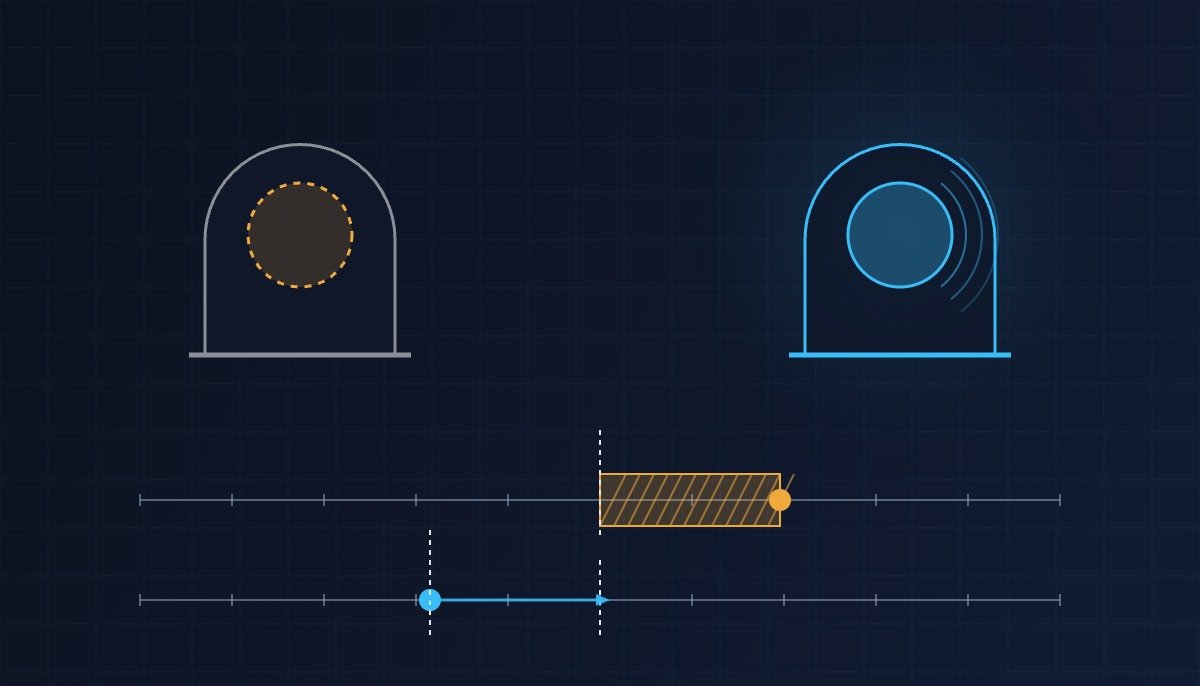
What changes when a different approach is applied can be seen in the US case. Hatch Units 1 and 2 received licences for a total of 80 years of operation in June this year. That came about a year after operator Southern Nuclear applied for second continued operation in May last year, with plenty of time left before the existing 60-year operating periods end (Unit 1 in 2034, Unit 2 in 2038). The first continued operation licences, extending from 40 to 60 years, were also obtained roughly 12 and 16 years ahead of the original operating licence expiry dates. On top of this, the US has a Timely Renewal provision: if continued operation is applied for at least five years before the existing licence expires, the existing licence remains in effect until a final decision is made, even if the review is not finished by the expiry date.
The connecting logic becomes clear when read in the language of control design. A continued operation review is essentially a matter of handling an undetermined signal: “whether the licence will be granted has not yet been decided”. Korea resolves this undetermined signal on the safe side, that is, to a stop (fail-safe). The US does not ultimately run without a licence either. But by forcing the application to be made five years before expiry, it pushed the time window in which an undetermined signal can occur out of the operating period altogether. It did not loosen the interlock; it moved the time axis forward so that the conditions for the interlock to trip never arise. That difference shows up as a KRW 440 billion outcome.
Comparing the systems: what creates an operating gap
Even among ageing plants with the same 40-year design life and from the same pressurised-water and boiling-water reactor families, outcomes split on three items of the review system. The table below contrasts the two cases using only reported facts.
| Item | Hanbit 2 (Korea) | Hatch 1 & 2 (US) |
|---|---|---|
| When licence obtained | After design life expiry, review in progress | Confirmed 8 and 12 years before existing expiry |
| Review focus | Ageing degradation + 14 periodic safety review (PSR) items + latest technical standards | Focused on ageing degradation (equipment ageing) assessment |
| If review is unfinished | Operator bears shutdown risk | Existing licence stays in effect under timely renewal |
| Operating gap | About 10 months (maintenance to end 2027-07-09) | None |
| Cost of gap | About KRW 440 billion assuming LNG replacement | Not applicable |
The row that actually decides the outcome in the table is not “review focus” but the single line “if review is unfinished”. It means the operating gap can be eliminated by institutional design alone, without reducing the number of review items.
Implications from a power system perspective
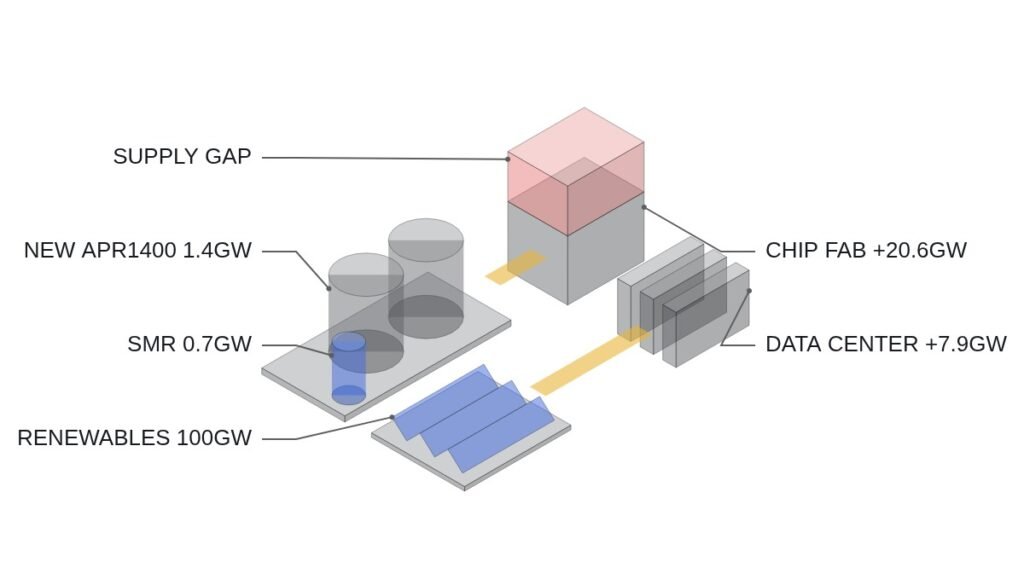
The KRW 440 billion figure is an estimate obtained by multiplying about 5.5 billion kWh of generation over 10 months, assuming an 80% capacity factor, by last year’s difference in average settlement price between nuclear and LNG of KRW 79.13/kWh. From a grid operation perspective, this gap is not just a matter of price difference. When one unit that carried baseload drops out of the grid, what fills its place is dispatchable gas-fired generation, which means the grid’s marginal generator (marginal unit) stays fixed on LNG for longer. The settlement price difference is the result of this structure persisting for 10 months, not its cause.
The difference in review focus is also worth noting. The ageing degradation assessment that the US concentrates on examines whether structural materials in contact with reactor coolant can keep holding up, and this area is supported by non-destructive evaluation techniques. The Korea Atomic Energy Research Institute’s registered patent KR101447012B1 (filed 2013-06-24, registered 2014-10-07, Active per Google Patents) claims a non-destructive method of assessing remaining life by forming short-range ordering (SRO, Short-Range Ordering) of alloy atoms in metal alloy structural materials for nuclear plants in contact with reactor coolant, then measuring changes in hardness, thermal conductivity and electrical resistivity. It should be kept distinct, however, that this patent claims only the assessment method and does not claim online application during operation or the continued operation review procedure.
One nuclear regulatory expert explained that “Korea has a structure in which the operator bears the risk of plant shutdown caused by review delays.” Another expert said that “plants subject to continued operation are effectively undergoing a review close to the level of a construction permit for a new plant.”
Items to verify also remain. The NSSC agenda plan (Kori Units 3 and 4 in the second half of this year, Hanbit Units 1 and 2 in the first half of next year) is only a plan, not a confirmed schedule, and the actual restart date of Hanbit Unit 2 will depend on the review outcome and the equipment upgrade schedule.
Boundary conditions: where the advantage flips
- The application timing premise: timely renewal works only on the condition that the application is made at least five years before expiry. If an operator applies late, the gap arises just the same under the same system. The system does not absorb the risk by itself; it absorbs it only when the preparation timing the system requires is met.
- Fixed assumptions in the cost estimate: KRW 440 billion is a value that fixes an 80% capacity factor and last year’s average settlement price difference of KRW 79.13/kWh. If LNG fuel costs or the settlement price structure change, this gap narrows or widens.
- The nature of the review scope: the 14 PSR items and reflecting the latest technical standards are not waste in themselves. The NSSC expert committee’s recommendation, in the Kori Unit 2 licence case, to “reasonably adjust” overlap between the PSR and items submitted for the operating change permit pointed to possible duplication; it did not mean deleting items. Whether there is duplication differs from plant to plant.
Taking all three conditions into account, the single selection criterion narrows to one. It is not how many days the review period was shortened, but whether a pending-decision period remains on the operating time axis. The former is a question of the regulator’s processing speed; the latter is a question of institutional design. Hanbit Unit 2’s 10 months were decided by the latter.
Source: Electric Times, September 10, 2026, “Hanbit Unit 2 stops for continued operation, while US plants never have to stop” (Korean). Patent bibliographic data and legal status from direct Google Patents lookup (2026-09-11).